
We spent yet another night at a Cracker Barrel, and so far, they've been great places to stay at in this part of the country--there are always dedicated RV/bus lots, and they've been safe and quiet spots to stay at. It probably won't be the last time we stay at a Cracker Barrel, so at some point we should probably dine there as a bit of a thank you for providing us with these spots!
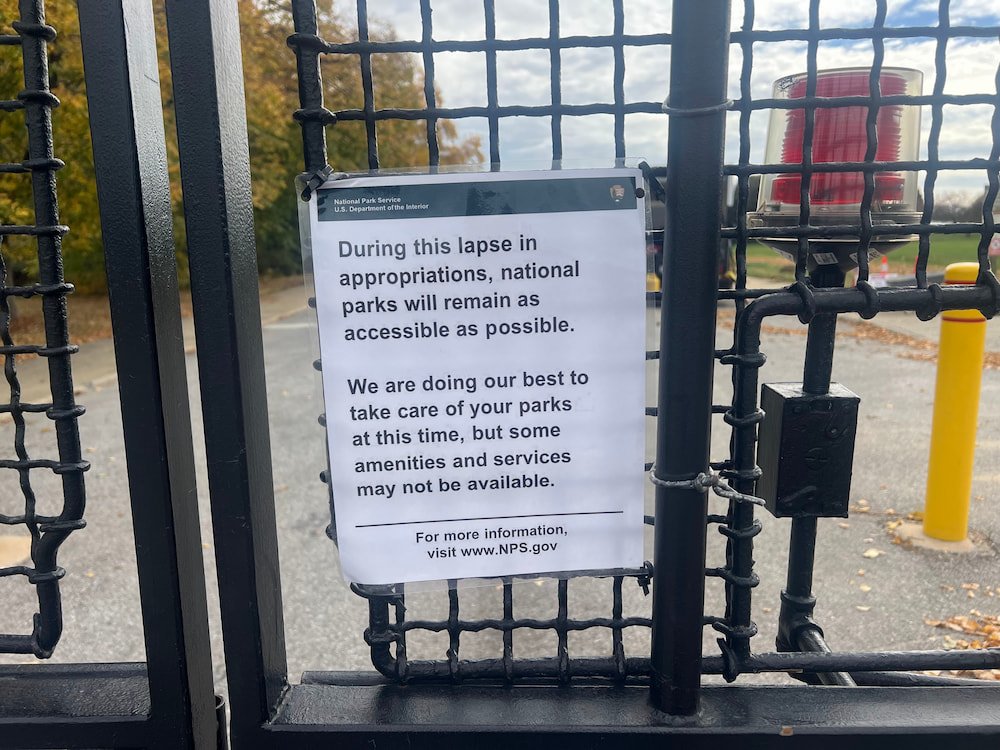
Continuing to Baltimore, we wanted to see the Fort McHenry National Monument and Historic Shrine, a historical pentagonal bastion fort that's best known for its role in the War of 1812, when it successfully defended Baltimore Harbor from an attack by the British navy from Chesapeake Bay on September 13–14, 1814. But alas! We arrived to find the place closed, thanks (well, not thanks) to the US government shutdown. Ugh, bummer! Michael tried to peek through the fence, but there wasn't much we could see behind the gate.
Observing the Park
Heading closer into the city, we found a free spot to park by Patterson Park, a recreational park where there were kids playing basketball, and folks running around, sidestepping the many squirrels darting along the grass along the way. This park also played a major role in the War of 1812, serving as the grounds where American troops stood ready during the decisive battle of North Point at Hampstead Hill.
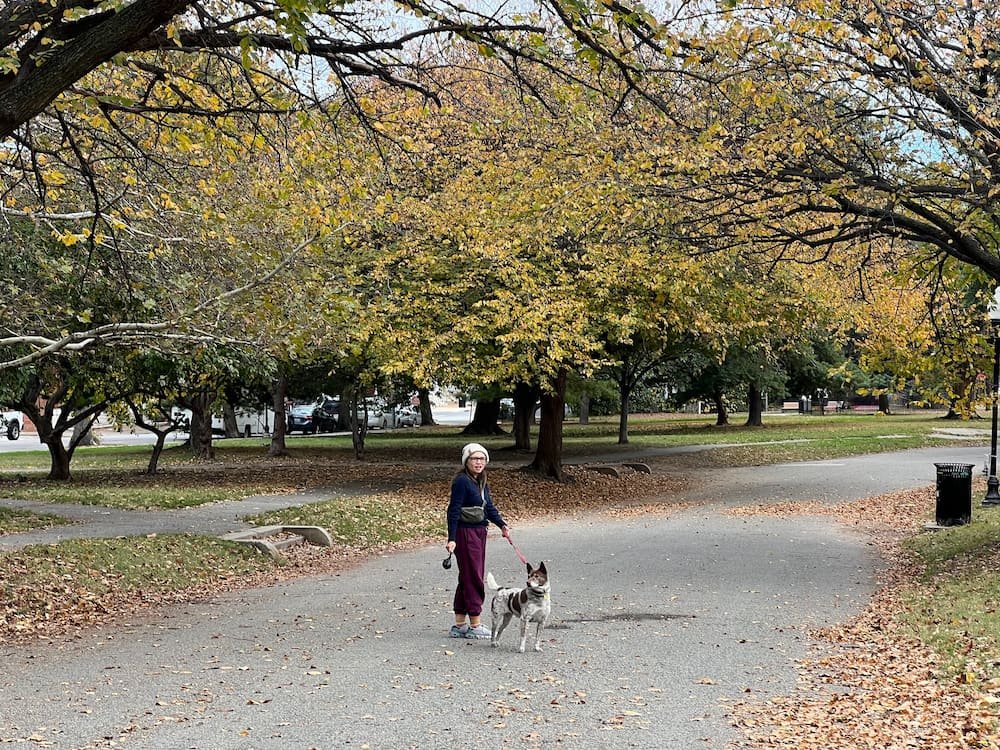
Since we were in a city with lots of places to check out, it was time for...e-bikes! There are probably only a handful of times left where we will be using them, so it's getting a bit sad to know this. Ahead of this trip Lisette didn't have a ton of experience cycling on the road and was a bit nervous about it, but she's become more comfortable during this trip and we both agree that it's been so fun and convenient to explore a city by bike--way more efficient than an RV, and a lot faster than walking everywhere. Plus Sheila has also become accustomed to being in her dog trailer, and often looks like she's having an absolute blast, grinning widely as we tour around.
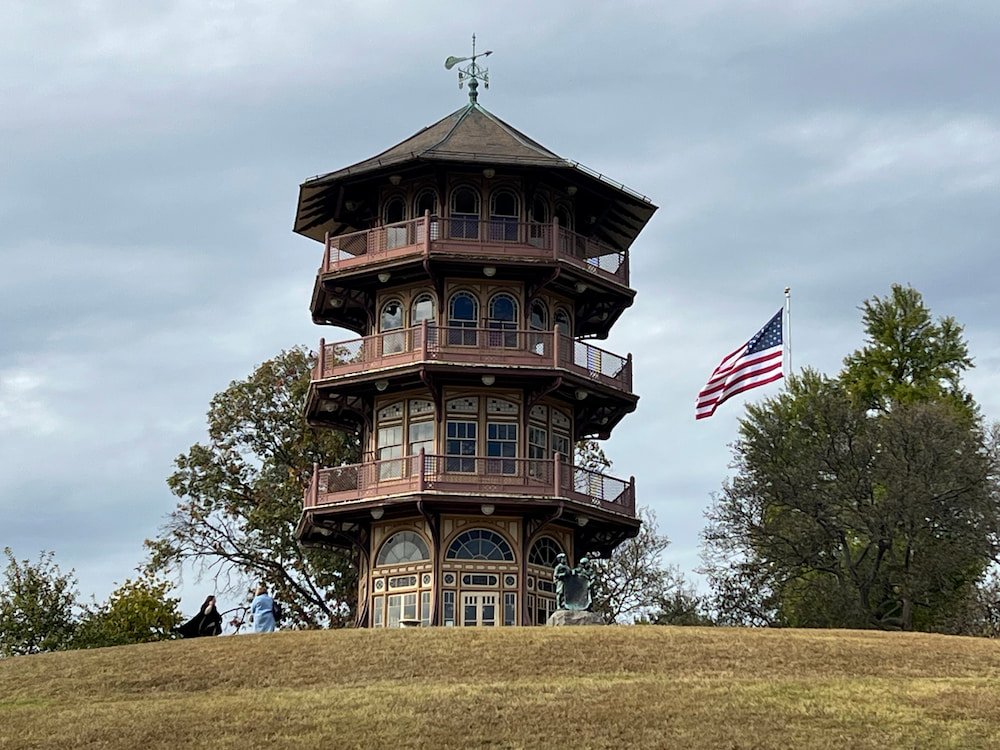
Once we had our e-bikes ready, we went to the The Patterson Park Observatory, which was built in 1891-1892 and took 6 months to complete. Its design accents reflect the Gilded Age interest in Asian architecture, which is why its also known as the “pagoda”. Built of iron, glass and wood and standing 60 feet tall on Hampstead Hill, the pagoda offers a 360-degree view of Baltimore’s many neighborhoods, but unfortunately it was undergoing renovations when we were there so we could only marvel at it from outside.
Brews, Shots, and Gas
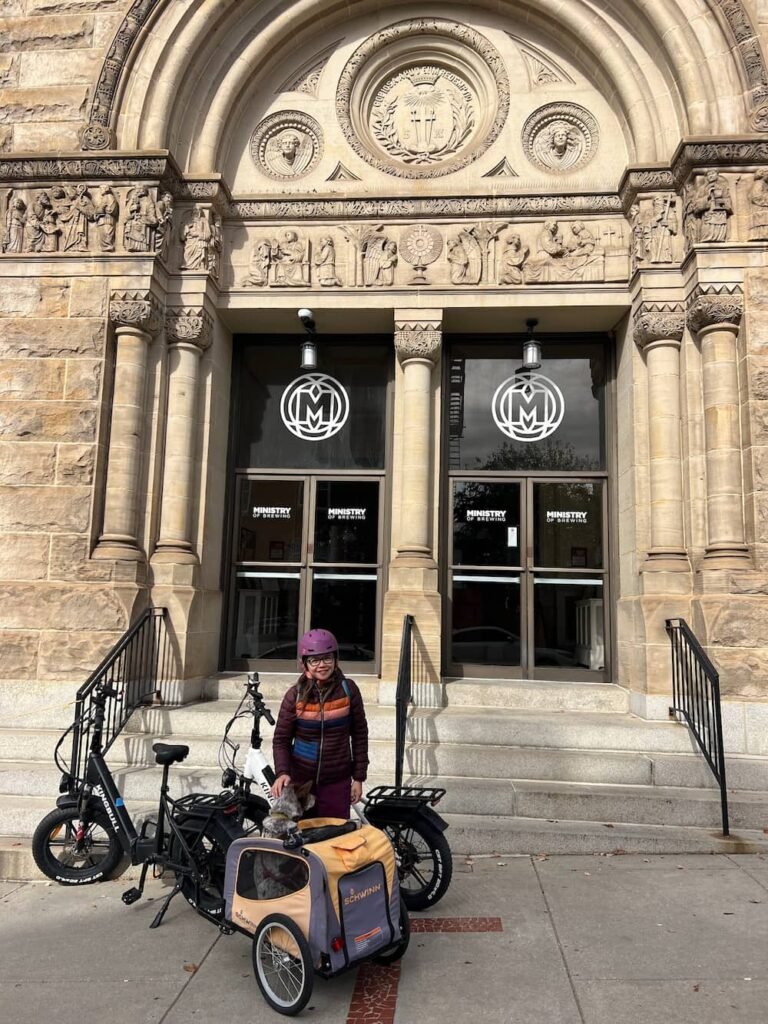
Our next stop was the Ministry of Brewing, a brewery set in what was once St. Michael’s Church. We didn't get to go in as we were too early (it's open in the evenings), but it looked cool from the outside, and reminded us of the other church-turned-brewery that we had visited in Pittsburgh, called the Church Brew Works.

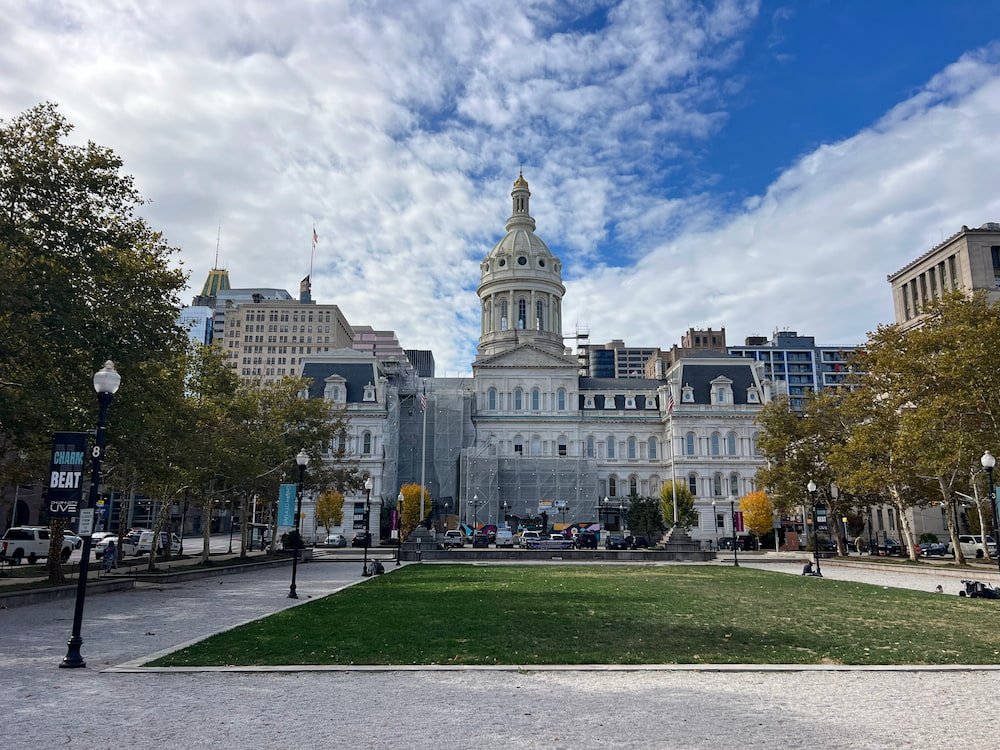
As we got closer to downtown Baltimore, we briefly passed the Phoenix Shot Tower, also known as the Old Baltimore Shot Tower. It's a red brick shot tower that stands at 234.25 feet tall (over 71 meters), making it the was the tallest building in the country when it was built. From 1828 to 1892, molten lead was dropped 215 feet to make shot for guns. For more historical and iconic buildings, we also took note of the Baltimore War Memorial, a prominent structure built in the Beaux-Arts and neoclassical architecture style, with tall Corinthian columns, limestone walls and carved stone reliefs. It was designed to honor Marylanders who died in World War I, and was completed in 1925. Across the road from this is the Baltimore City Hall, with its distinctive Second Empire architecture, a grand and ornate style popular in the late 19th century. As one of the prime examples of this French-inspired civic design, one of its most distinctive features is its mansard roof, topped by a 228-foot central dome made of white marble. How wonderful to see such a wide array of architectural designs in the country, and so much history in this part of the US!
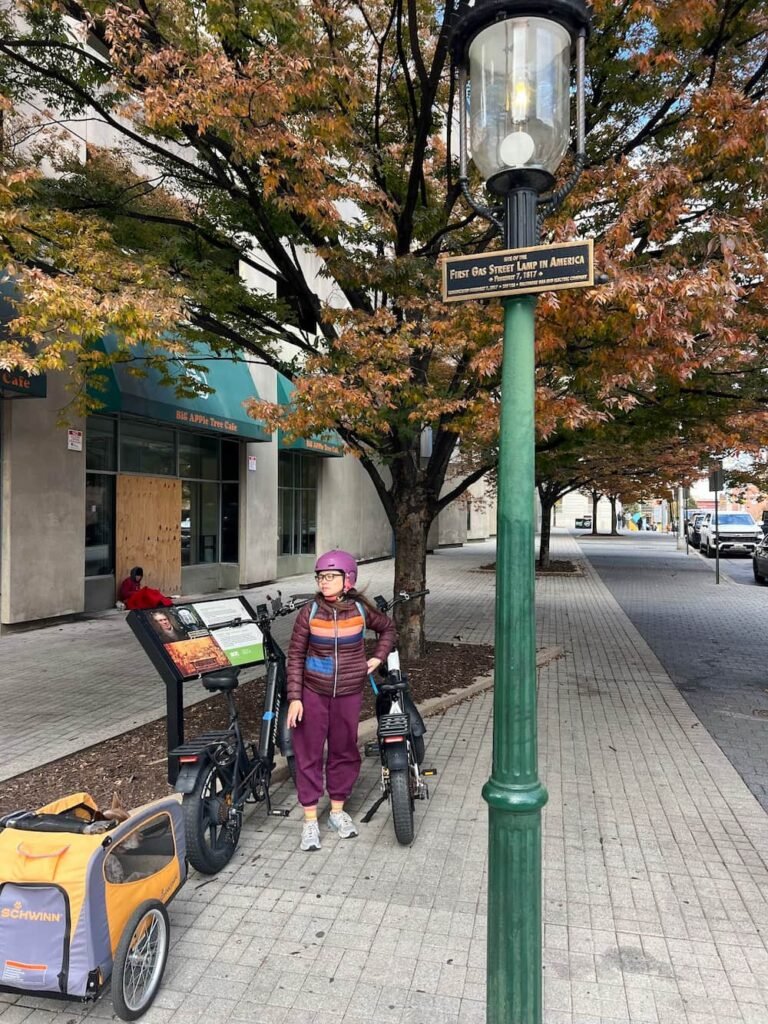
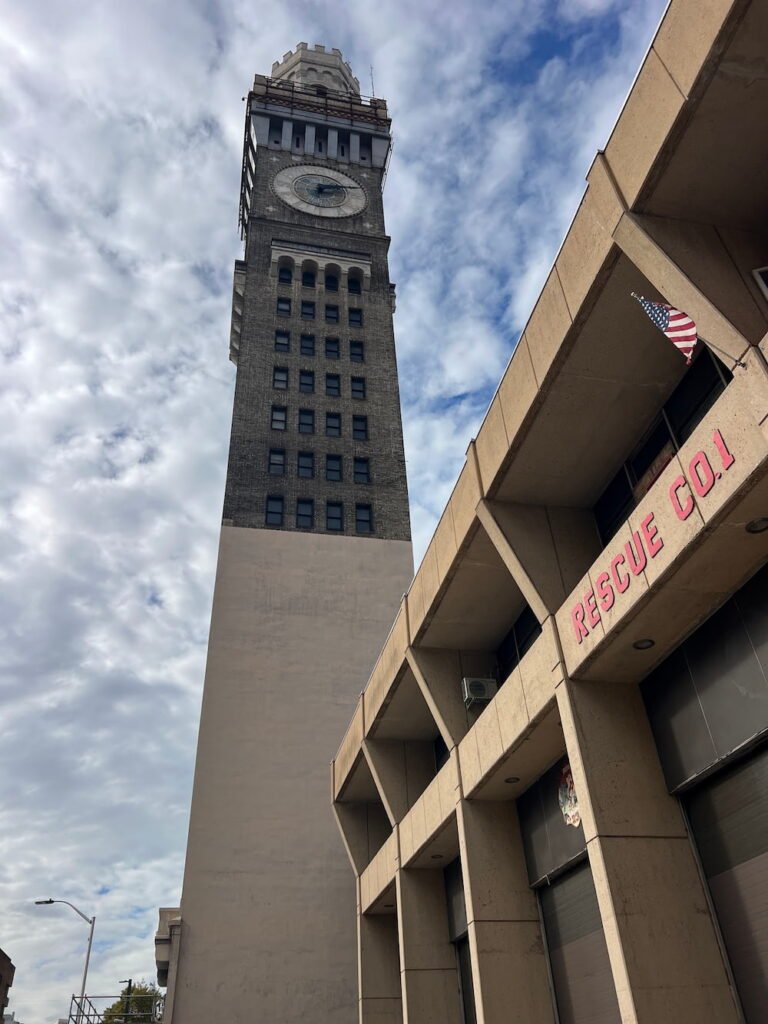
Not to be outdone, it took us a while to eventually find the First Public Gas Street Lamp in the country, which we're sure countless locals have walked past without realizing its historical significance. On February 7, 1817, Baltimore installed and lit its first gaslight on North Holliday and East Baltimore Streets. The lamp is on a black pole, and looks somewhat old school, but it still took us a while to figure out its exact coordinates. Another quirky historical attraction is the Bromo Seltzer Arts Tower, a 15-story clock tower built between 1907 and 1911, and commissioned by Isaac E. Emerson, the inventor of the Bromo-Seltzer headache remedy. At one point, the clock tower spelled out “B-R-O-M-O S-E-L-T-Z-E-R” instead of traditional numbers on the clock face, and was topped with a rotating 51-foot blue bottle of Bromo-Seltzer that was visible for miles.
Baseball, Railroads, and Ravens
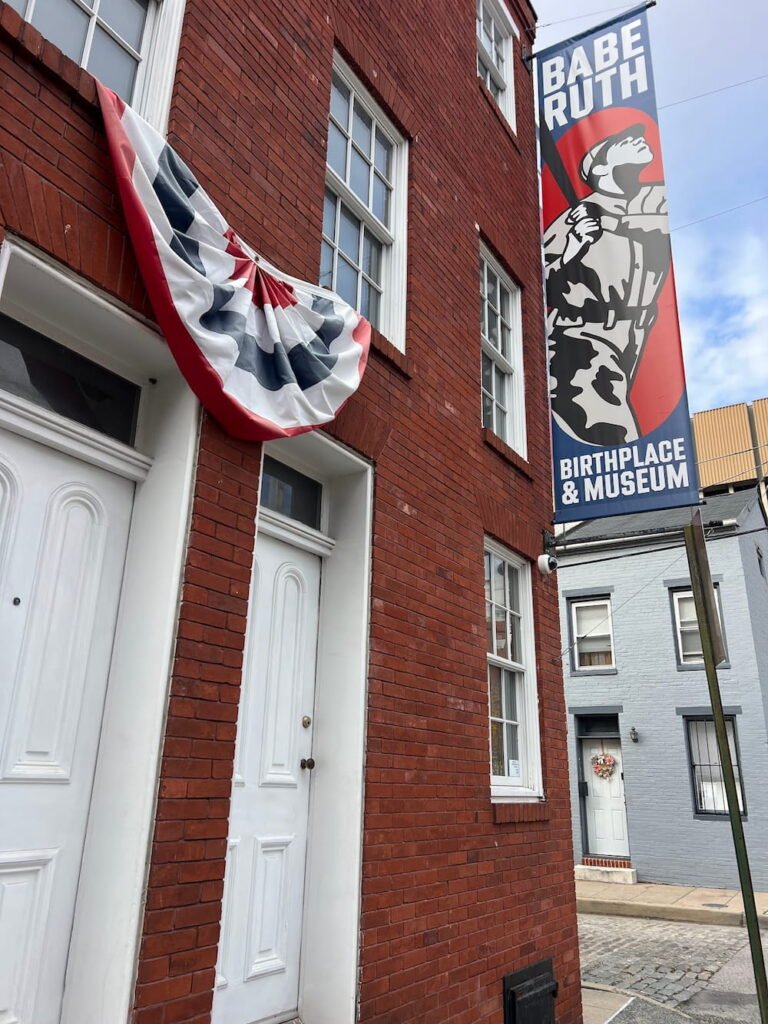
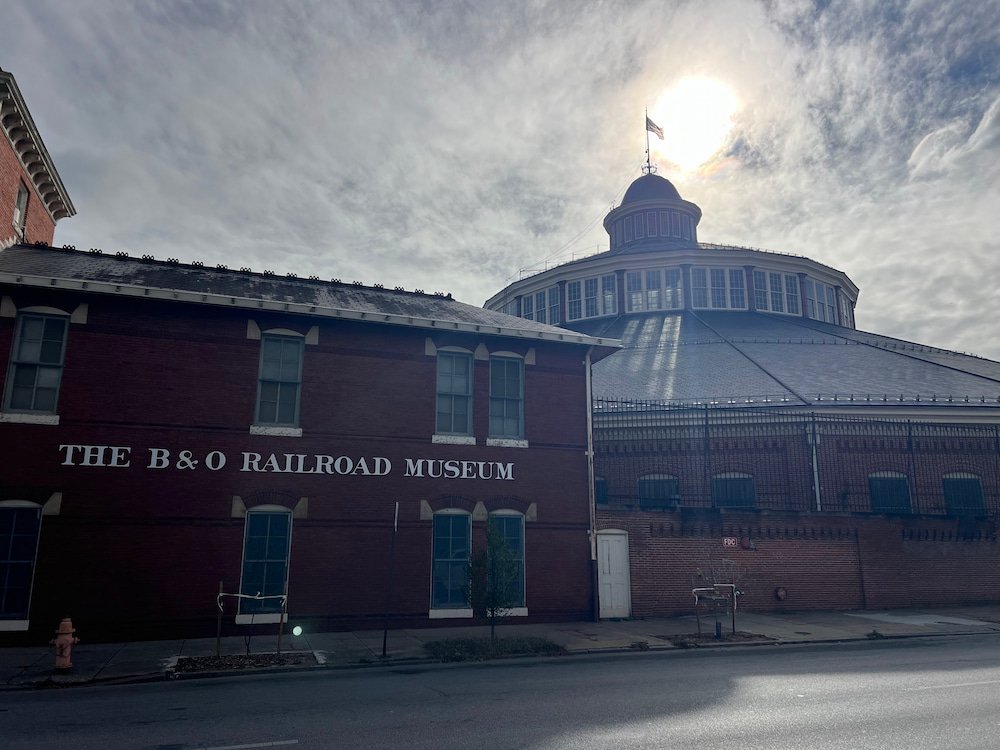
One of the most famous baseball players of all time is Babe Ruth, whose career spanned from 1914 to 1935. It turns out that he was born in Baltimore, and the house where he was born is now the Babe Ruth Birthplace & Museum, which has a collection of artifacts from his life. We didn't go in, but it costs $15 for admission. The B&O Railroad Museum is another museum close by, which apparently boasts the oldest and most comprehensive railroad collection in the world.
We'd seen quite a bit about Edgar Allan Poe when we were in Philadelphia, as the stuffed raven from his famous poem is on display there, as is the Edgar Allan Poe National Historic Site, a well-preserved home where he lived for several years. But Baltimore also lays claim to the macabre writer and poet, as he lived in the city on two separate occasions and died here. We now have a clear connection as to why the city's professional football team is also called the Baltimore Ravens, which was chosen by the fans in a 1996 poll.
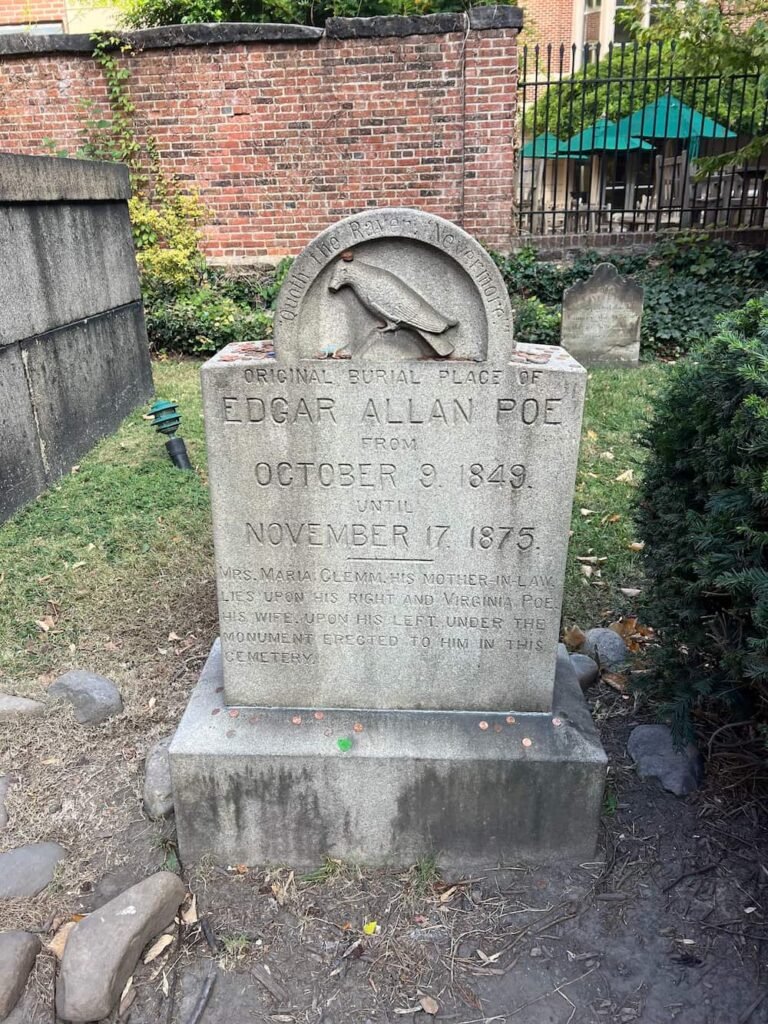
At Westminster Hall (also called Westminster Burial Ground), the church's grounds have a number of gravestones, which include the burial site of Edgar Allan Poe. He was originally in an unmarked grave at the back of the cemetery, but was later moved to a monument closer to the entrance, where he is buried next to his wife and mother-in-law. We could see the site of what was the original resting place, as well as the more prominent monument.
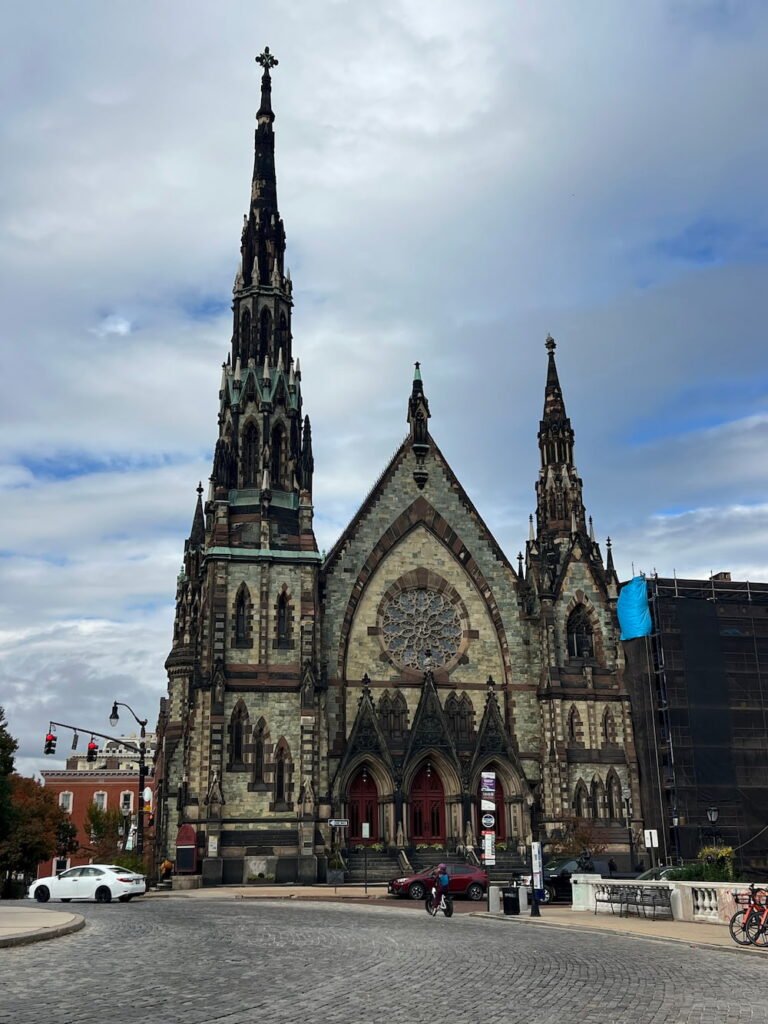
Our next stop was to another church, the Baltimore Basilica, a less morbid visit to see the country's first cathedral. It's a humungous edifice, with two domed structures on the roof, and domineering white columns all along the front entrance. The basilica offers guided tours, but visitors can simply go inside and see the equally impressive and opulent design inside.
An Old Dog and Other Old Things
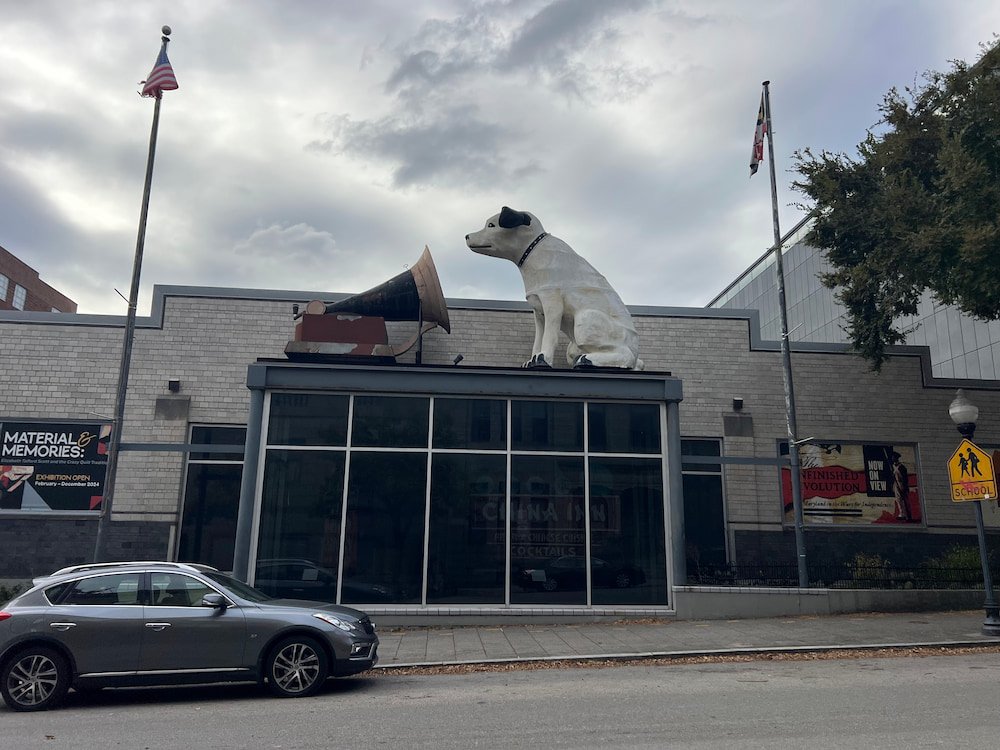
When we were in Albany, New York, we'd seen Nipper, a 28 foot tall, 4 ton statue of a fiberglass dog that was the logo for RCA, a now defunct electronics company. It turns out that Nipper also exists in Baltimore, where he's perched on the top of the Maryland Center for History and Culture, permanently facing a phonograph, where it's easy to imagine that he's listening to music playing from it. Nipper in Baltimore looks less neglected and more content than in Albany!
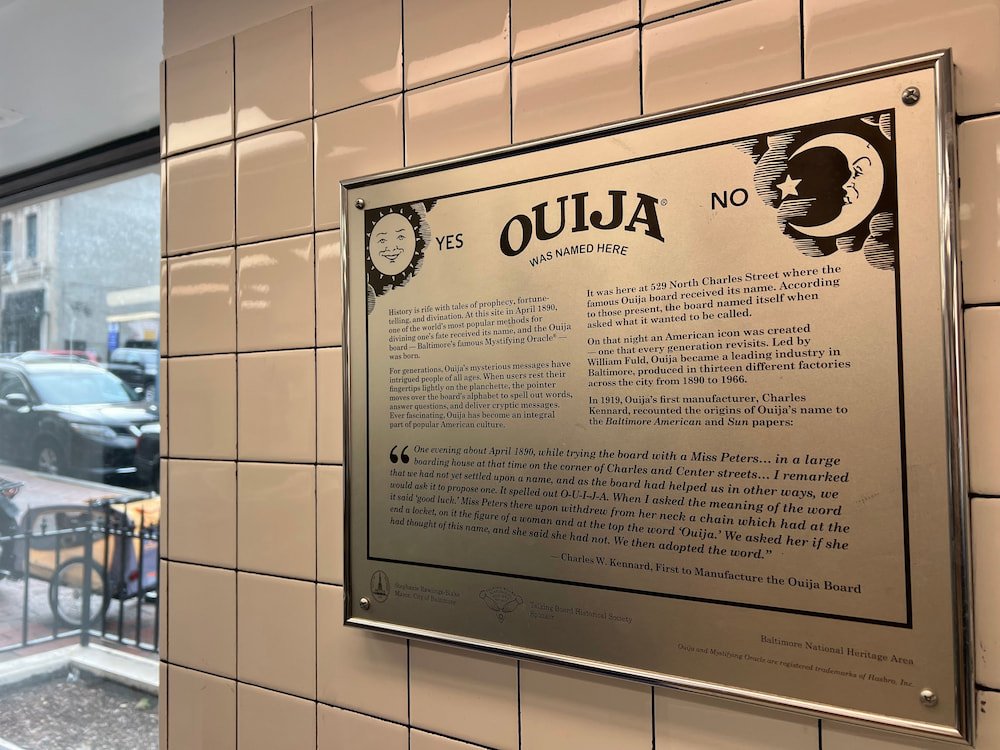
Random fact: the Ouija board, which is used to try to communicate with spirits, was named in Baltimore...and the plaque commemorating where it was named is in a 7/11 convenience store! The board was named in 1890 when Elijah Bond, the patentee of the board asked the board what it wanted to be called. The seance to name the board occurred in a boarding house known as the Langham Hotel, which is now the 7/11 location, and the plaque is immediately to the right upon entering the store. Among the fluorescent, artificial lights and ultra-processed food options, it's anything but a spooky setting for this historical event!
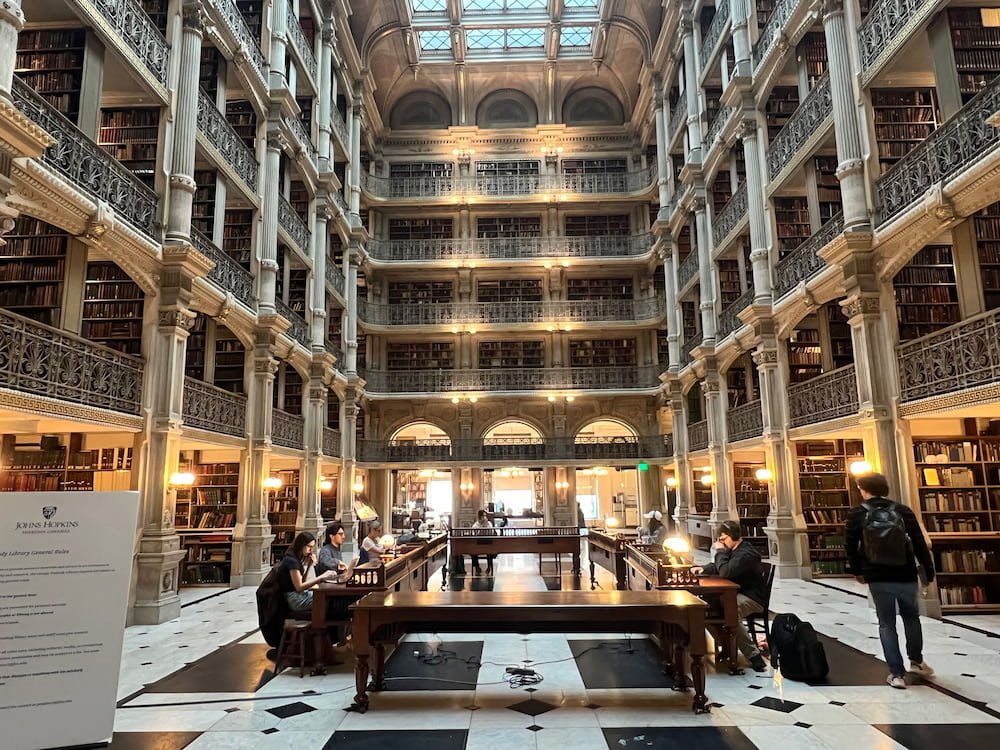
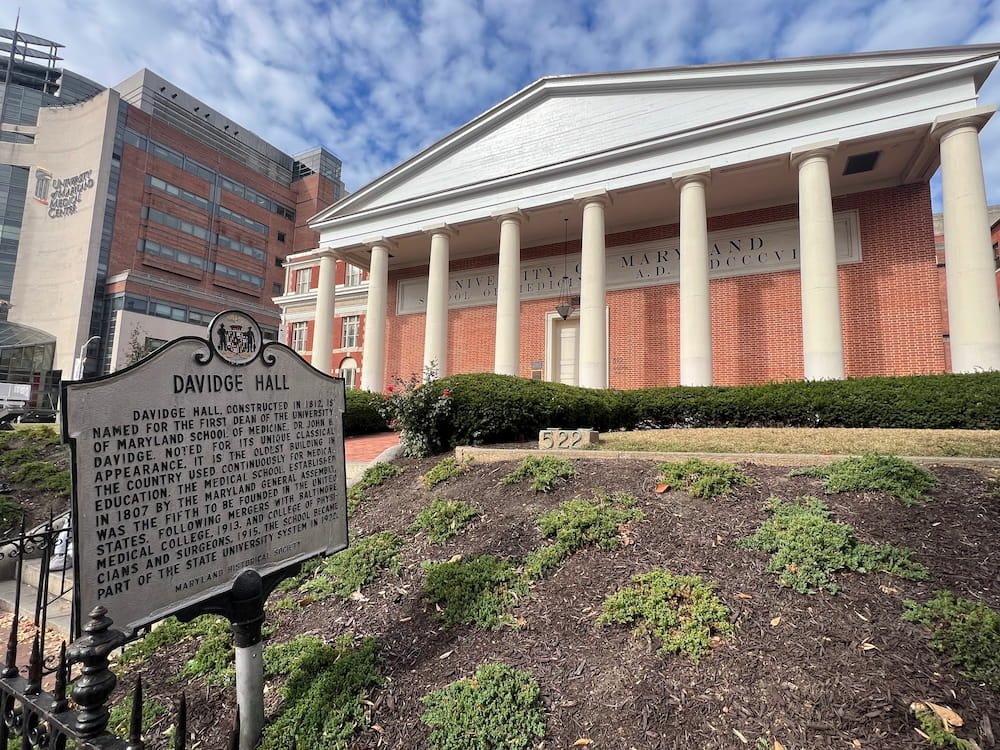
Across the road and up the hill is Johns Hopkins University, yet another beautiful university with its incredible architecture. One of the highlights for us was the George Peabody Library, which features an awe-inspiring stack room with 5 tiers of ornamental cast-iron balconies that rise dramatically to the skylight 61 feet above the floor. We were gobstacked when we entered this room--it's almost unexpected and so stunning to see in person! The library has 300,000 volumes from the 19th century, with topics including religion, British art, architecture, Romance languages, geography, and exploration. The upper floors can only be accessed by staff and are cordoned off; there were folks studying when we went in, but we could imagine being easily distracted if we were here!

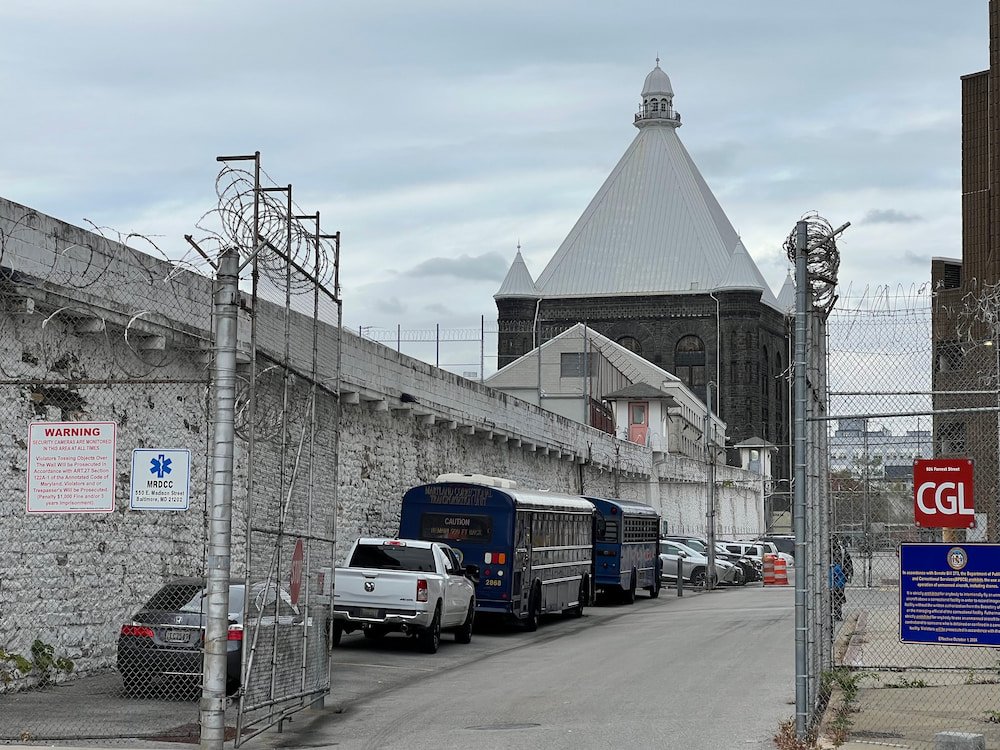
As we were cycling around the city, we suddenly noticed a very formidable prison, with its intimidating stone structures reminiscent of penitentiaries we'd seen like the Old Joliet Prison in Illinois. This made sense since the jail in Baltimore was in 1801, and it seems that prisons constructed during this century had the same domineering, Gothic style. The Baltimore City Detention Center also had barbed wire all around it, making it look even more intimidating, and we'd later learn that unsurprisingly, scenes from the TV series "The Wire" were filmed here, and the Baltimore City Detention Center has a long history for being old, corrupt, and dangerous.
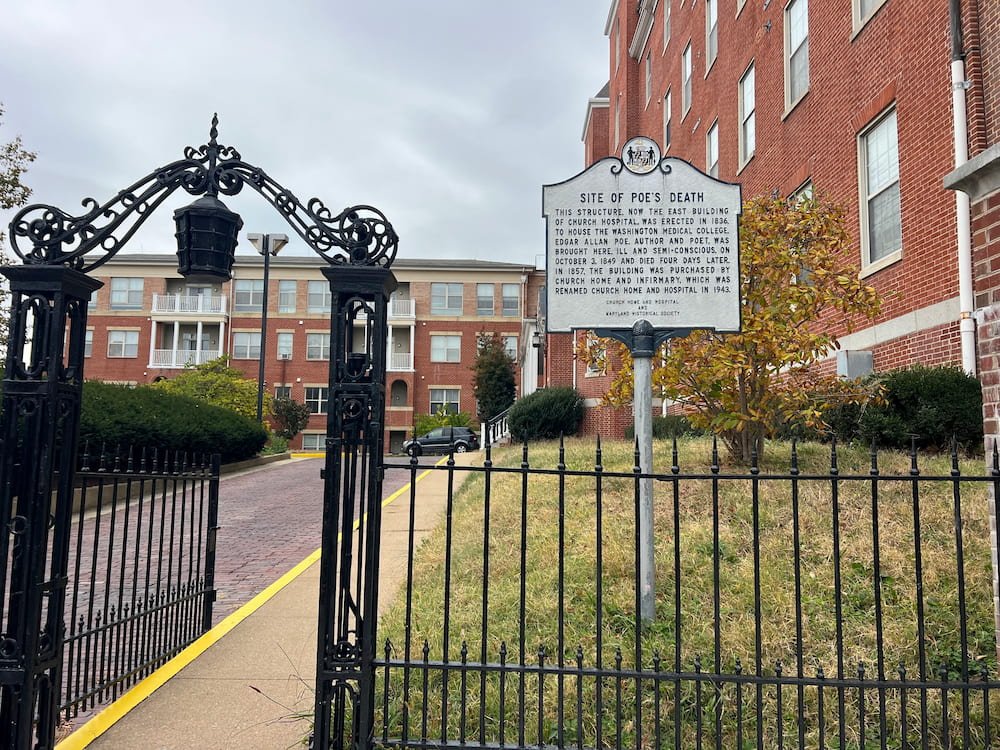
Our last stop was the site of Edgar Allan Poe's Death. We thought the site would be more fascinating given his macabre reputation, but there's simply a plaque outside what was once Washington University Hospital (now a townhouse development) noting that he died here. While there's not much else beyond the plaque, the cause of his death remains a mystery, and all of the relevant medical records have been lost, including his death certificate.
Returning to the RV, we considered leaving our spot to park somewhere else, but rationalized that we had a free spot already locked in here where we could stay for the night. Overnight, there was a heavy downpour that kept us up for a bit, with the raindrops falling heavily onto our RV roof, but the din also meant that it seemed there the traffic tapered off into the night as folks likely stayed indoors. Another day of exploring tomorrow!