
While we'd experienced our first chilly night in months in Salem a couple of days ago, we were pleasantly surprised to have temperatures warm enough to be wearing t-shirts again in Boston, with the sunny skies perfect for exploring the city on e-Bike. Since we've been to Boston before, we decided that we'd see some places in the morning, before heading towards Cape Cod in the afternoon.
The North End
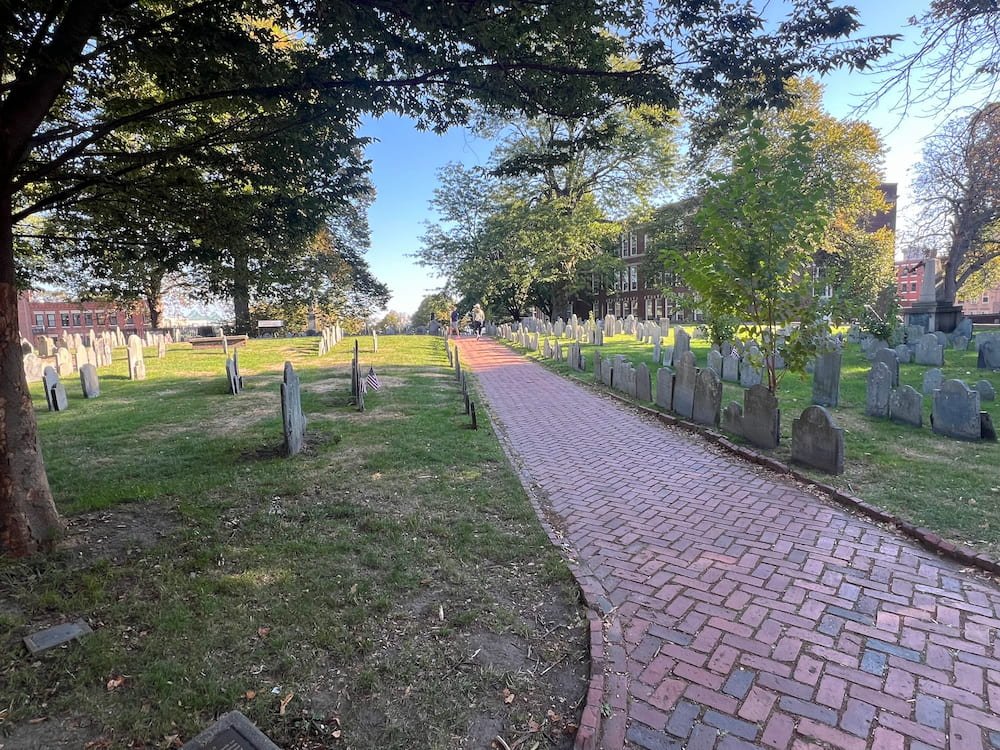
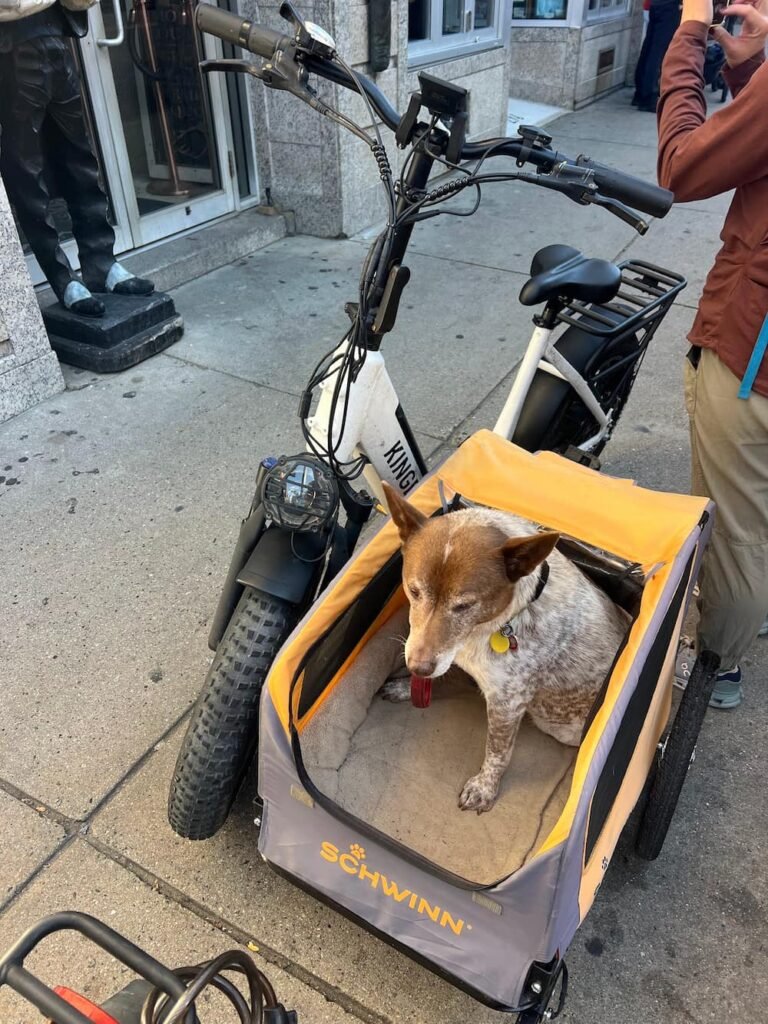
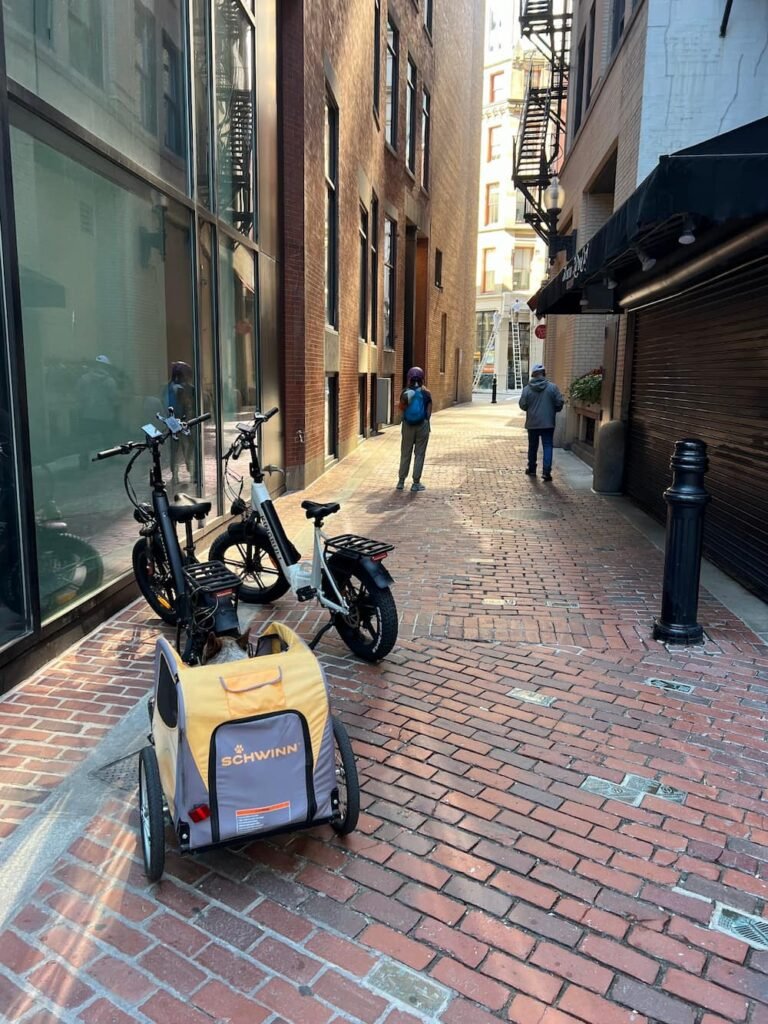
Because we've explored cities on e-Bikes quite a bit recently, Michael is very efficient in getting the bikes down from the rack, assembling them, and attaching Sheila's dog trailer--we're ready to ride in no time! We crossed the North Washington Bridge into the North End of Boston first, seeing Copp's Hill Burial Ground, Boston’s largest colonial cemetery that's been around since 1659. It's part of the Freedom Trail, the 2.5-mile red-brick-lined path that people can easily follow that connects to 16 significant historic sites, so we bumped shoulders with a lot of tourists as we checked out nearby sites like the "Skinny House" across from Copp's Hill Burial Ground--a 4-story house that has the title of being the narrowest in Boston, measuring a mere 10.4 feet (3.16 meters) at its widest part.
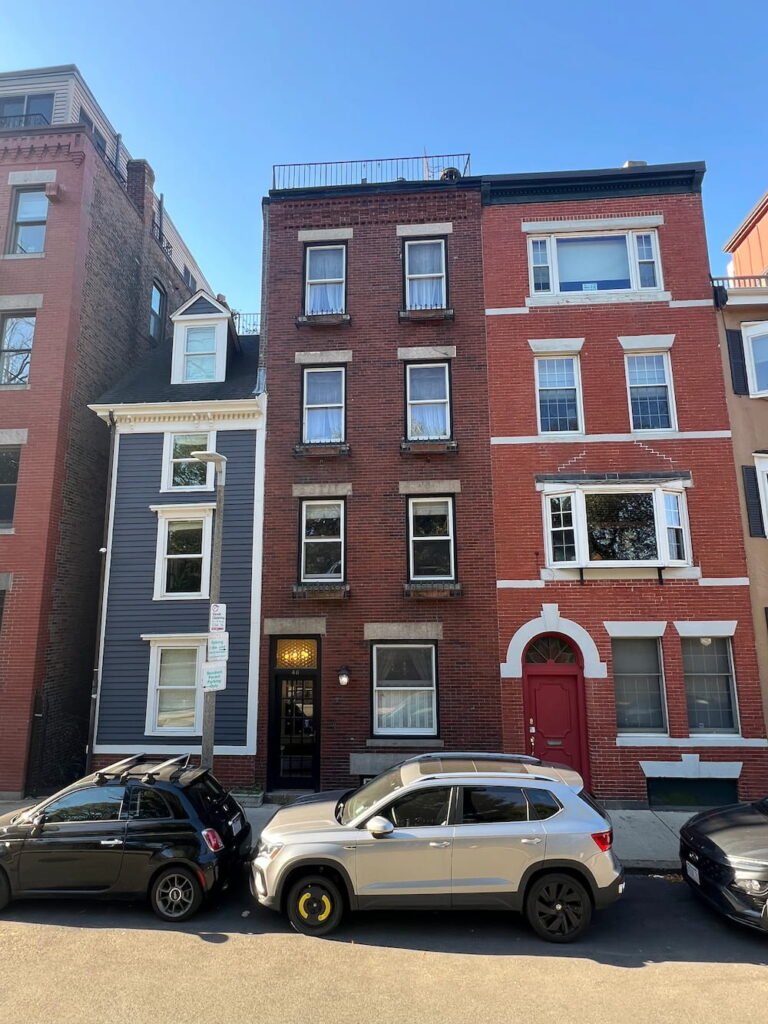
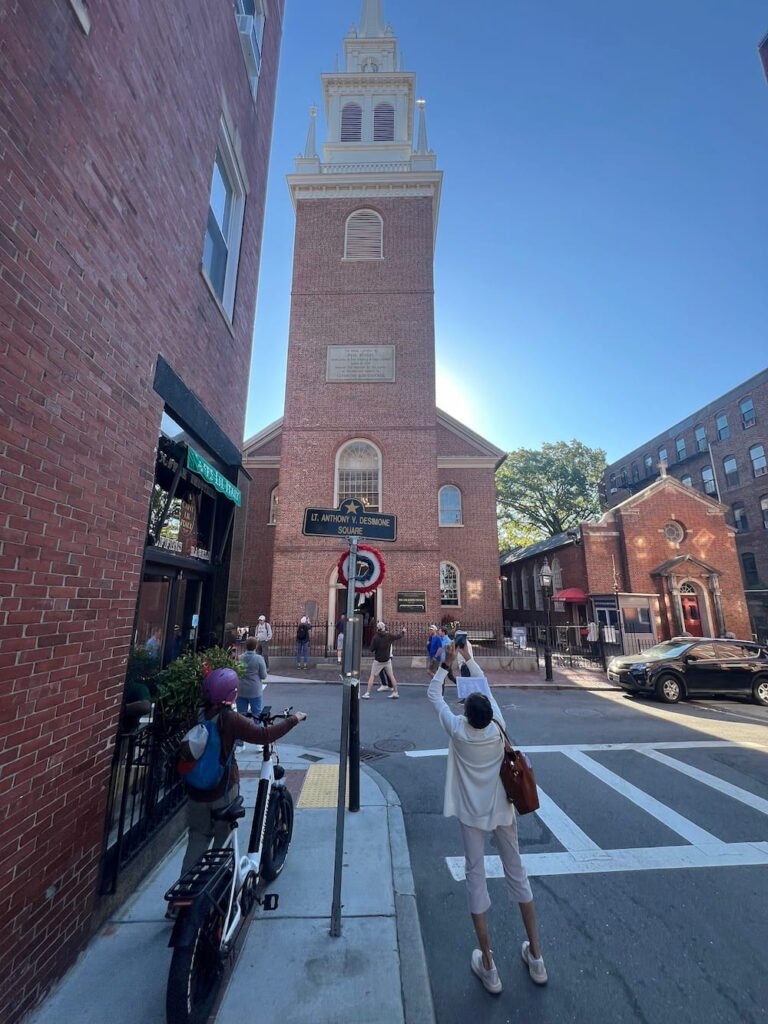
The house is also within sights of the Old North Church, the oldest standing church in Boston that was built in 1723. It was in the steeple of the church that Paul Revere warned the country of British troops marching towards them ("The British are coming!"), and there's a plaque to commemorate this event that occurred on April 18, 1775.
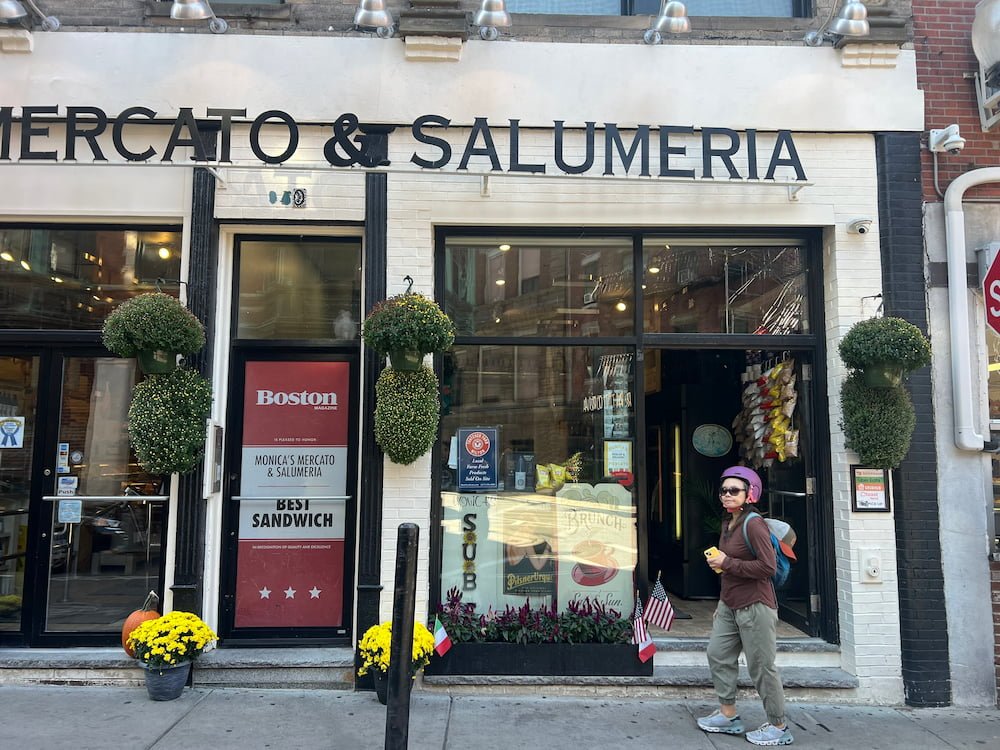
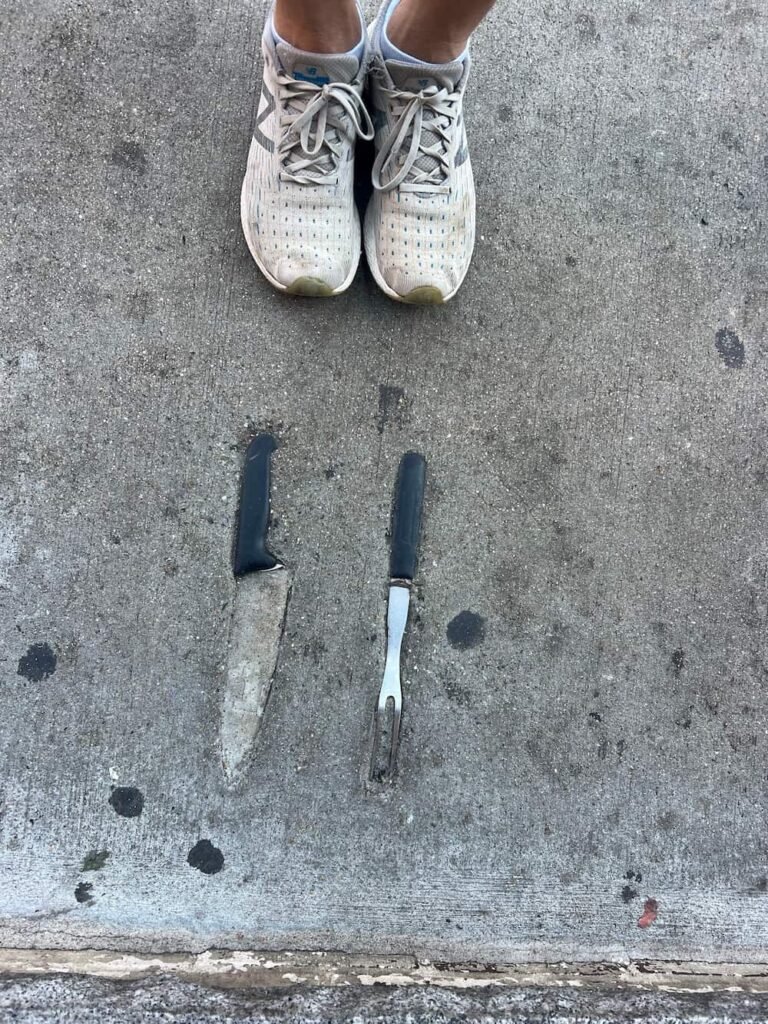
The North End of Boston is also famous for being the city's "Little Italy", so we rode past Italian cafes, restaurants and grocery stores in this neighborhood. There was an Italian-American family chatting to a friend as we stopped to get our bearings, the parents encouraging their kid to say something in Italian, while speaking English in thick Boston accents--so the heritage of Little Italy is certainly alive and well here! It took us awhile to spot the North End Street Utensils here, but on the ground in front of Monica's Mercato and Salumeria we found a knife and grill fork embedded on the cement. Apparently the tradition stems from Italy, to symbolize a deli. In the neighborhood we also cycled past Caffé Vittoria, Boston's first Italian cafe, and a bunch of other cafes and pastry shops that we were almost--almost!--tempted to go into and buy stuff from, had we not had a decent breakfast, and stuffed our faces here on a prior visit.

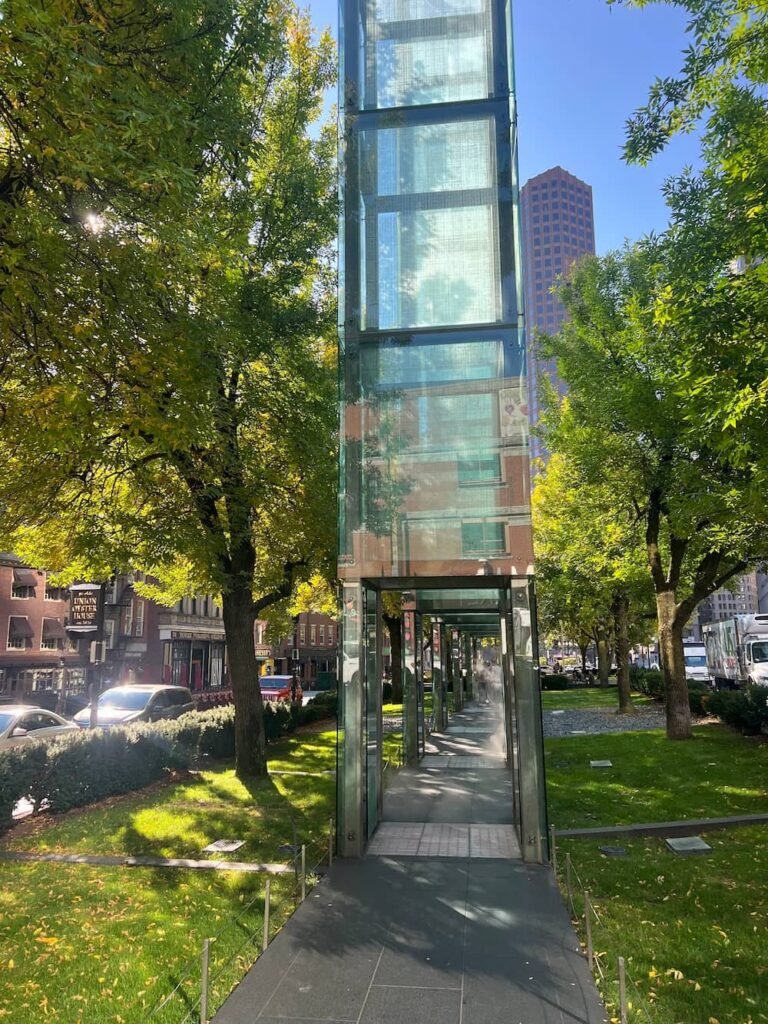
Further south but still near the Freedom Trail is The New England Holocaust Memorial, which consists of 6 illuminated glass towers symbolically etched with 6 million numbers--the number of Jews who were murdered during the Holocaust. We could walk through a path between the glass towers, where steam was rising up around us, reminiscent of the gas chambers that were used to murder Jews. There are quotes from survivors noting their experiences, and it's a very symbolic, thoughtful and certainly poignant memorial.
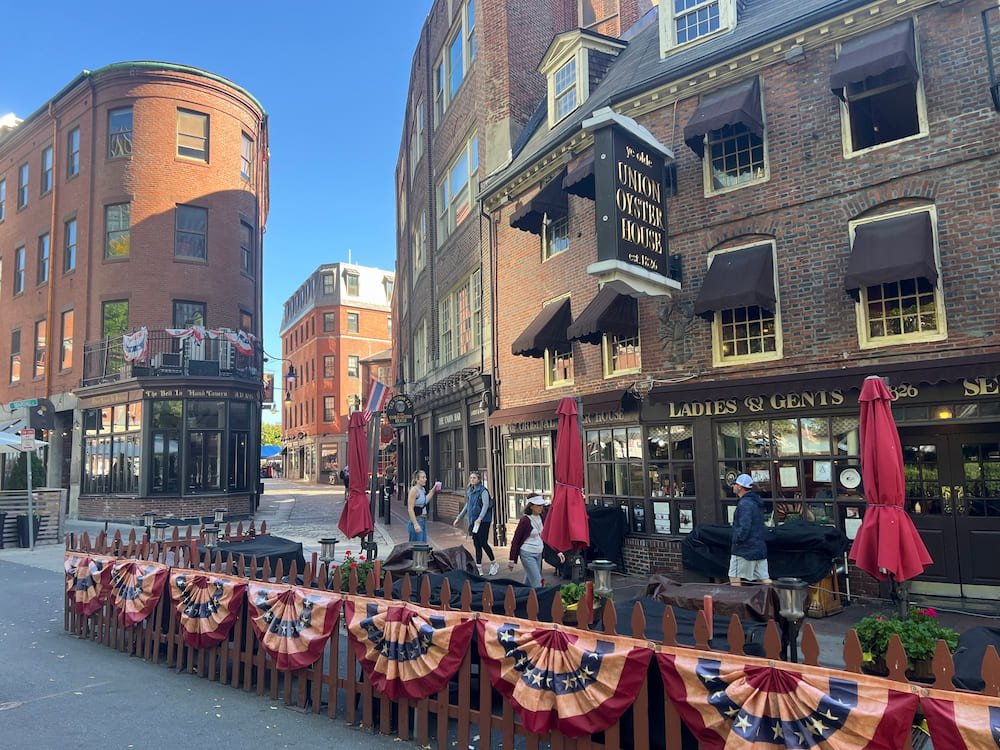
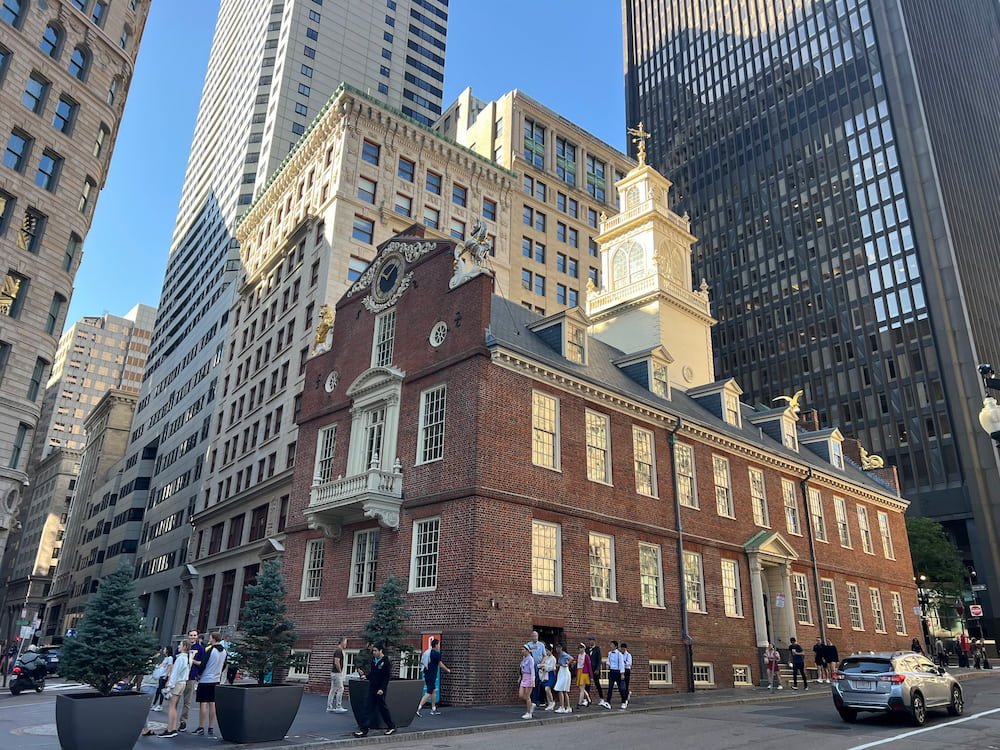
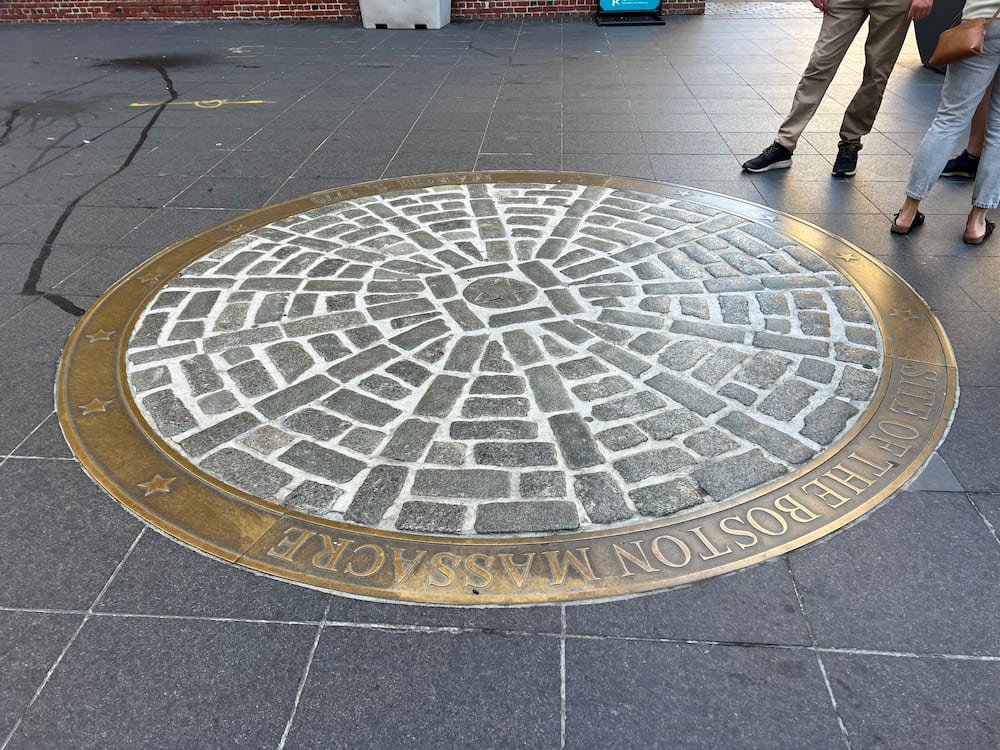
We still weren't hungry, but nearby is the Union Oyster House, Boston's oldest restaurant that has been serving seafood and other grub since 1826. Also on the Freedom Trail, in front of the Old State House (the original colonial seat and state capitol), is a memorial on the ground commemorating the Boston Massacre Site. On March 5, 1770, an group of colonists taunted British soldiers by throwing snowballs and rocks, leading to the first bloodshed in the American Revolution.
The Seaport District
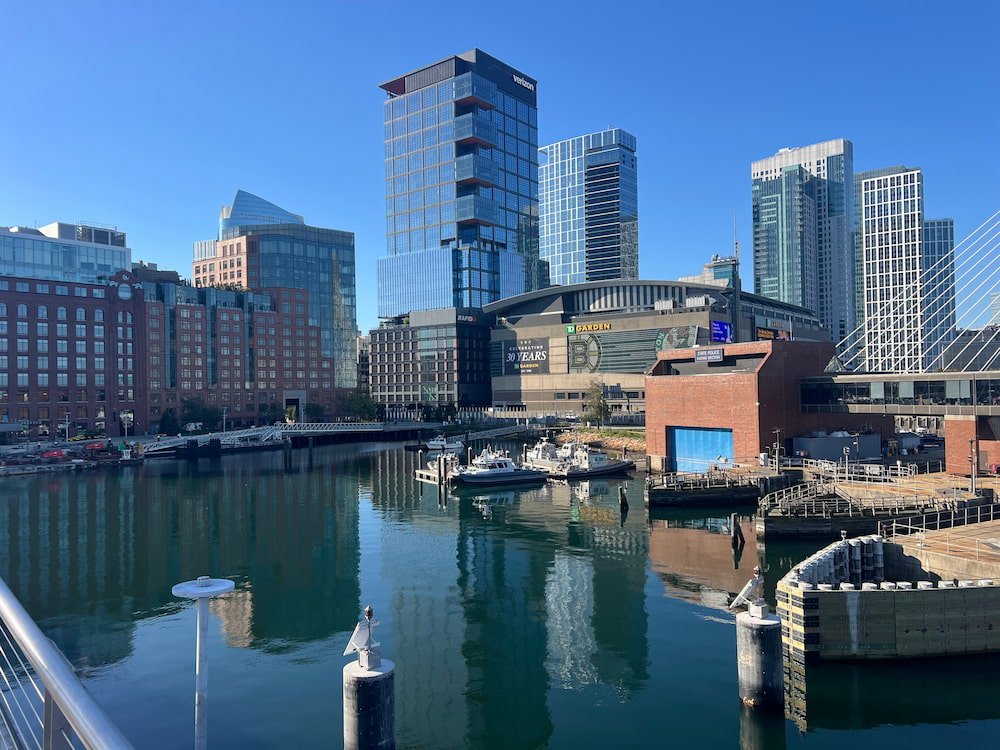
Crossing another bridge, we arrived at the Seaport District of Boston, enjoying the beautiful sunshine beating on us as we looked out onto the water, and the Boston Tea Party Ships & Museum, which details and reenacts the events surrounding the Boston Tea Party, a protest in 1773 where American colonists, disguised as Native Americans, dumped chests full of tea into Boston Harbor to protest the Tea Act, leading to the American Revolution.

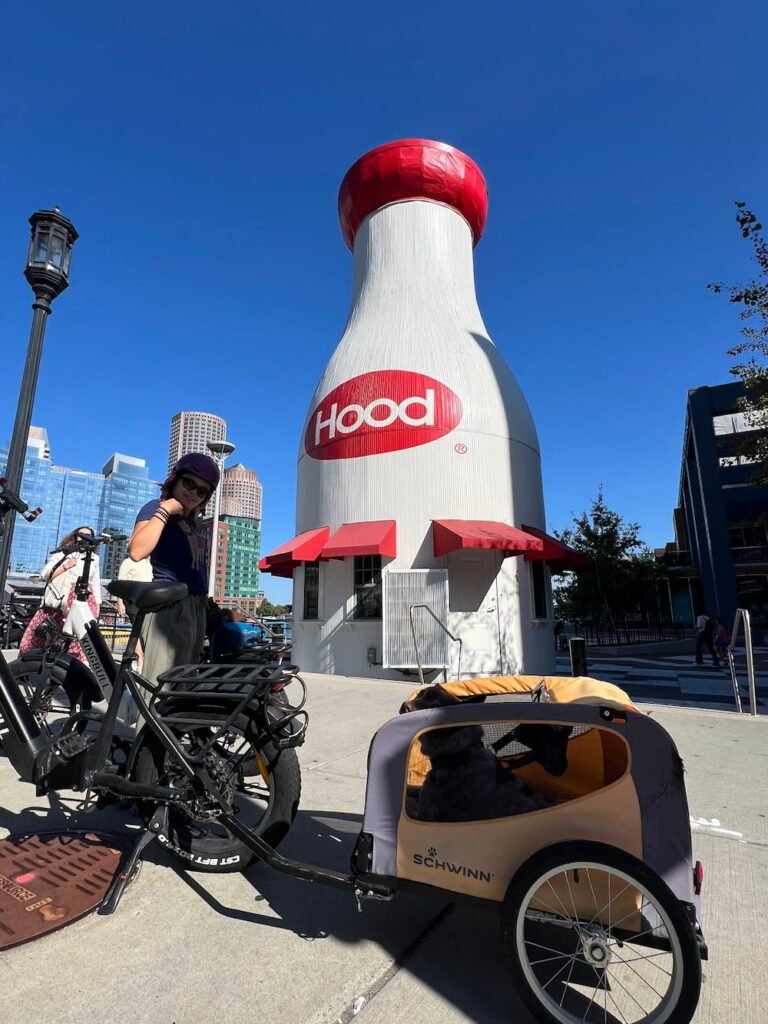
In Seaport we saw the Hood Milk Bottle, a giant, 40-feet (over 12 meter) tall milk bottle that's next to the Boston Children’s Museum, which was built in 1930 by Arthur Gagner to help attract customers to his homemade ice cream store next door. In this neighborhood, after passing so many cafes, Michael finally succumbed to buying a coffee (he hadn't had one this morning as we'd run out of milk), and Lisette went in to Little Wolf Coffee to order a flat white for him. While the person at the cash register said they could make a flat white even though it wasn't on the menu, when the barista gave it to her...it was tiny, like the size of a cortado! We have a feeling that was what it was. Michael said the coffee was good, but definitely wasn't what we ordered. The coffee was decent, but the store was definitely on the hipster side. It's the type of establishment where everyone working there looks cool and indifferent, and the coffee is more expensive than you were expecting.

Martin's Park is a creative park for children, designed in memory of a victim of the Boston Marathon bombing. The park has some really beautiful murals in it that are worth a look, with inclusive and welcoming messages in them. There was one that focused on women's rights, and even had a serpent on the huge mural that looked like it came from a traditional Aboriginal Australian dot painting.
Back to Downtown Boston
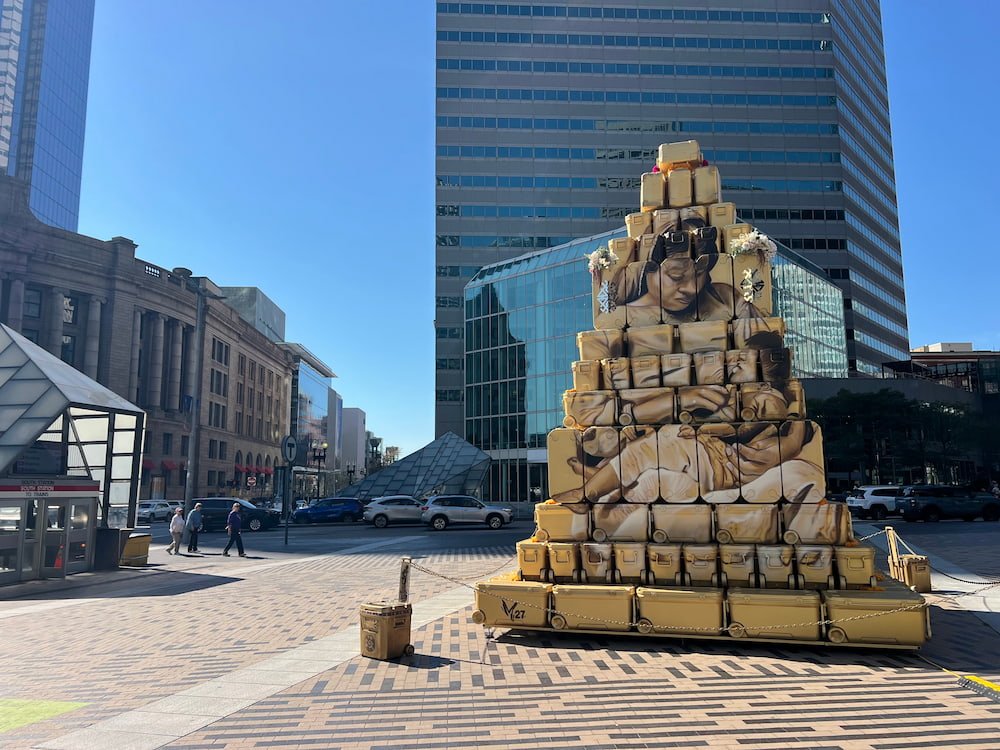
Speaking of artwork, near the South Station of Boston there's an art installation called "Elevar La Cultura", made entirely out of coolers (we call them Eskies in Australia), which are stacked to form a pyramid and painted gold, and is inspired by Latin street food vendors and undocumented workers. It turns out that the installation--which is in Boston until December before it travels around the country--has smaller details that, if you didn't look closely, challenge the Trump administration’s immigration policies.
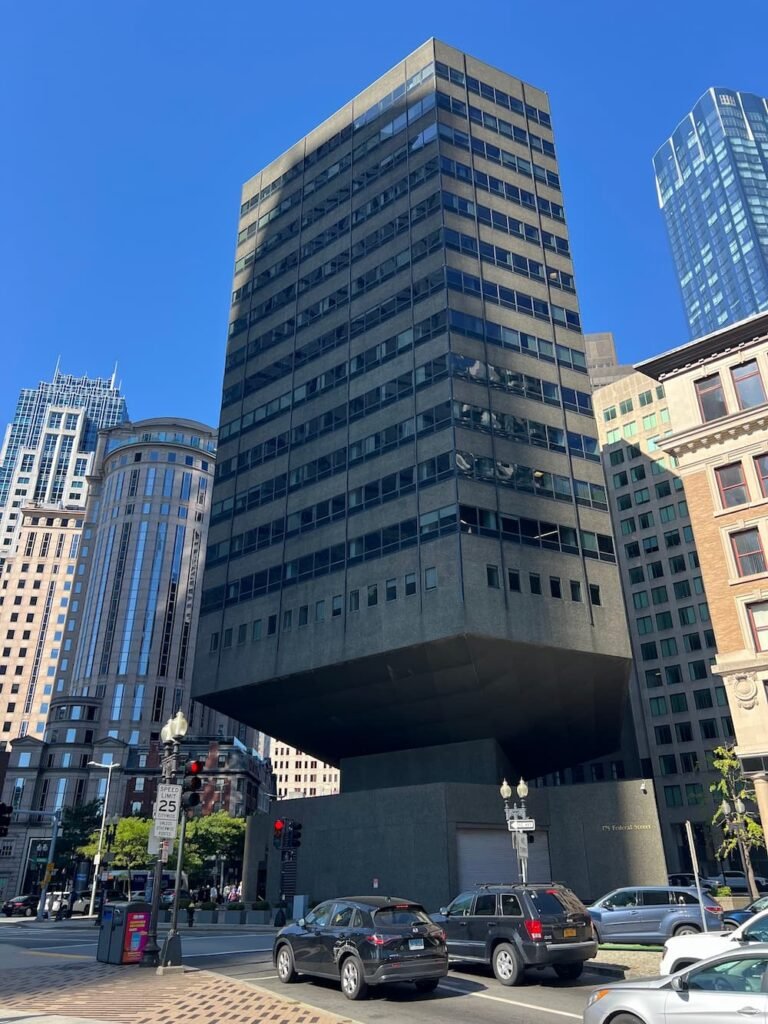
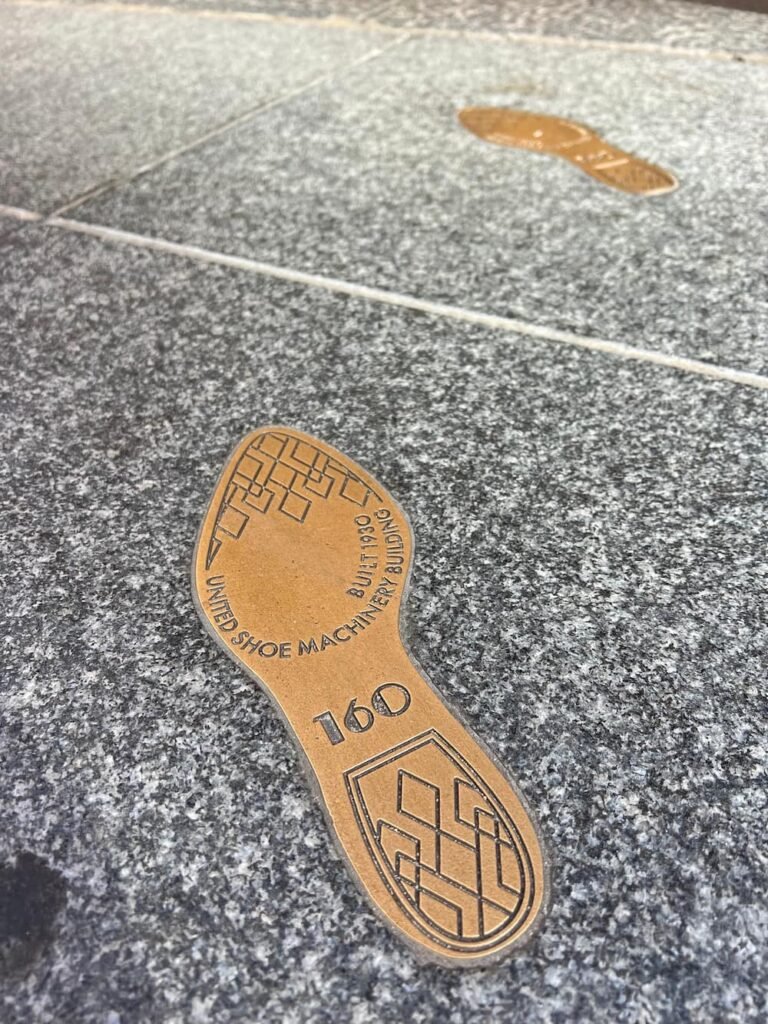
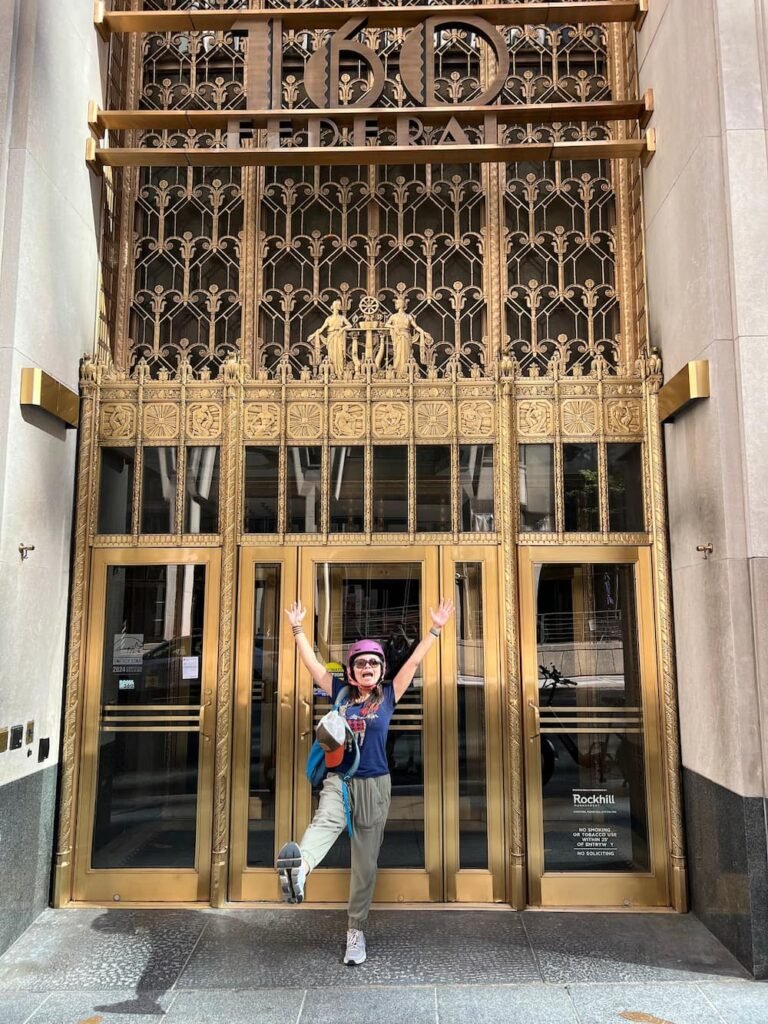
One of Boston's most exquisite Art Deco edifices is the United Shoe Machinery Corporation Building in the Financial District. Of course, it has a lot of gold finishings and motifs, and the 24-story structure was built between 1929 and 1930. Because it has a shoe legacy, there are even shoe prints of what looks like someone wearing a leather shoe leading up to the building, which end as it arrives at the revolving door entrance. Very cool!
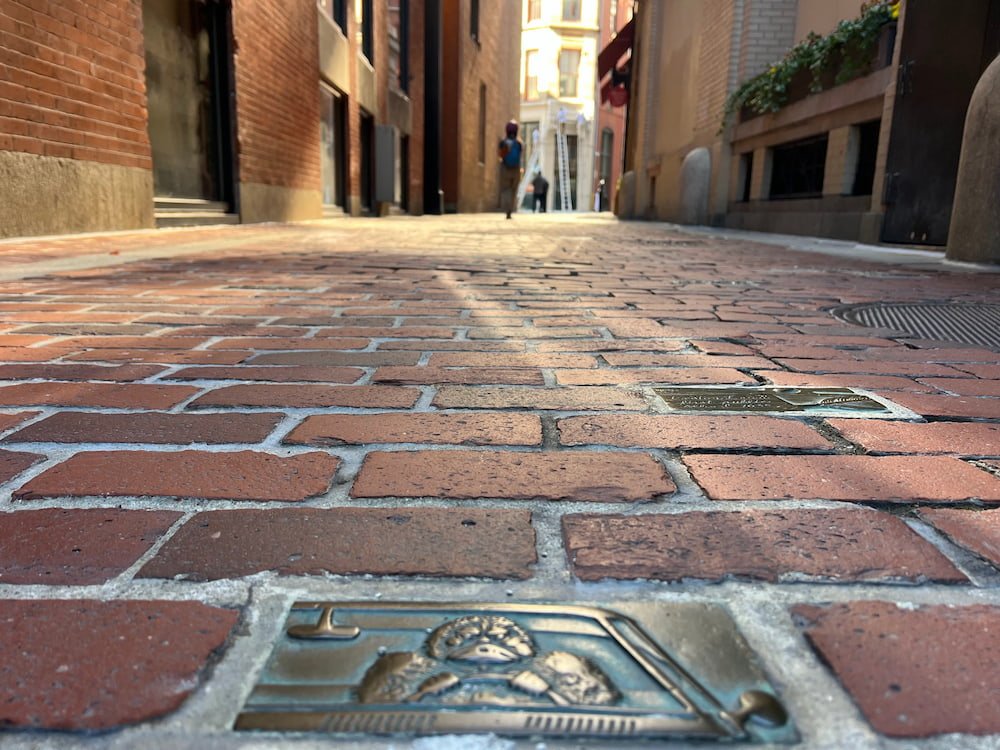
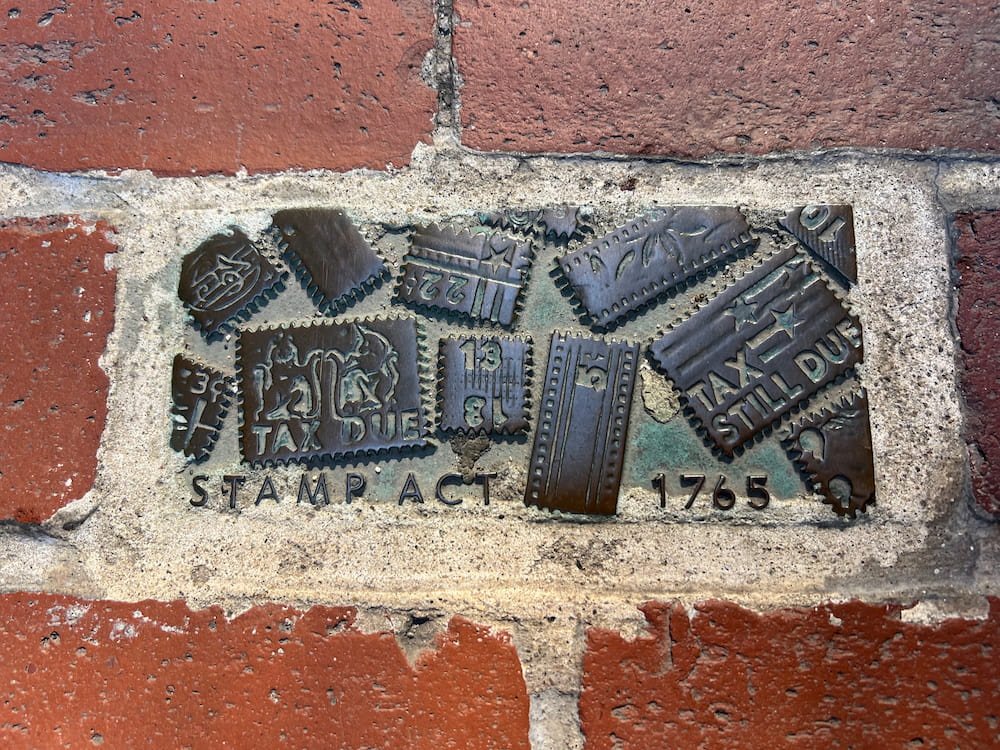
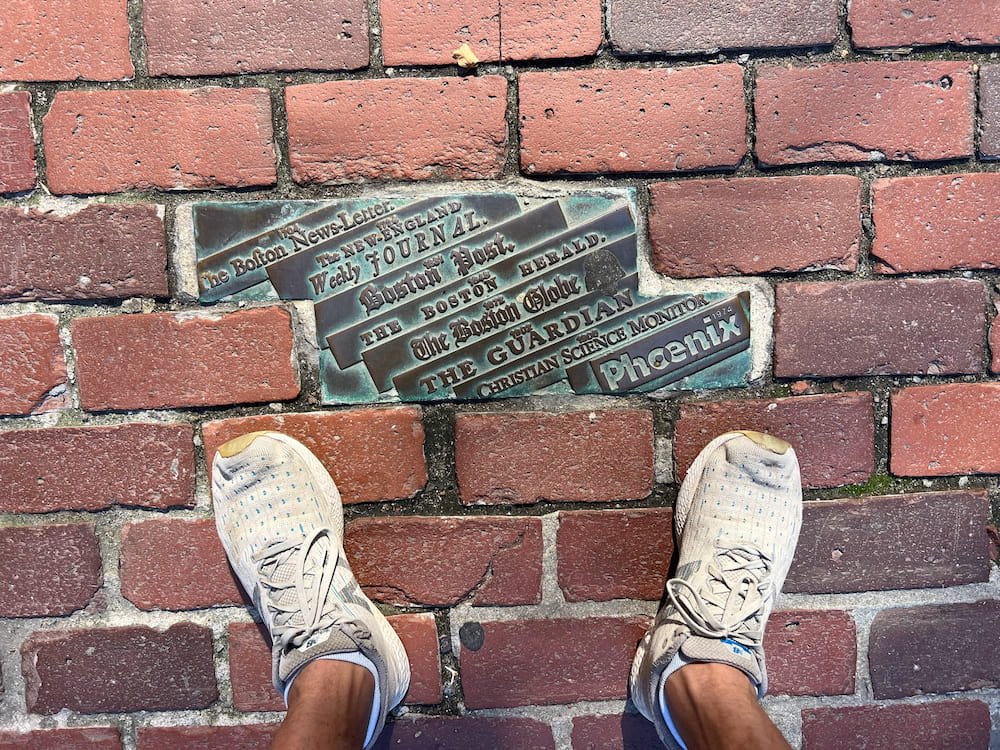
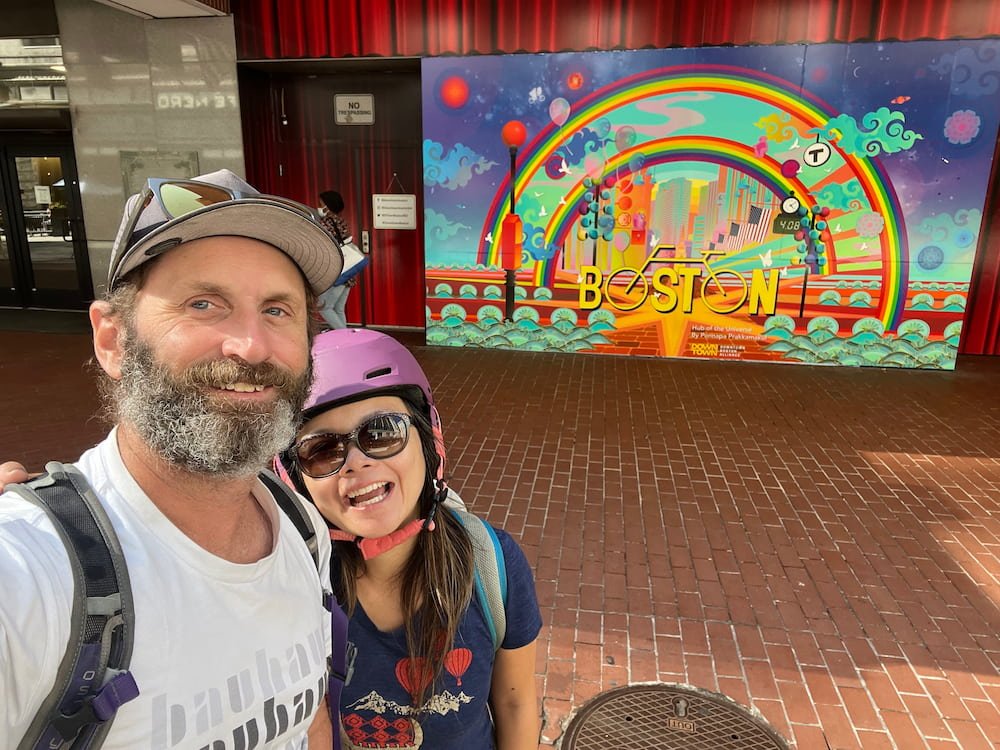
Another place that's best looking at the ground is in a small alleyway, called Winthrop Lane. In this lane between Otis Street and Arch Street, we saw the Boston Bricks, a series of about 100 bronze bricks with various images carved into them on the floor, and spaced out from each other. There's one of what looks like a Yeti driving, a sign for the North Pole (3,180 miles away!), an image of various newspaper mastheads, and more. Each brick relates to a key Boston event, and it was fun to simply walk from one end of the quiet lane to another, head down, peering at the various bricks to see what they commemorated.
The Oldest...Something
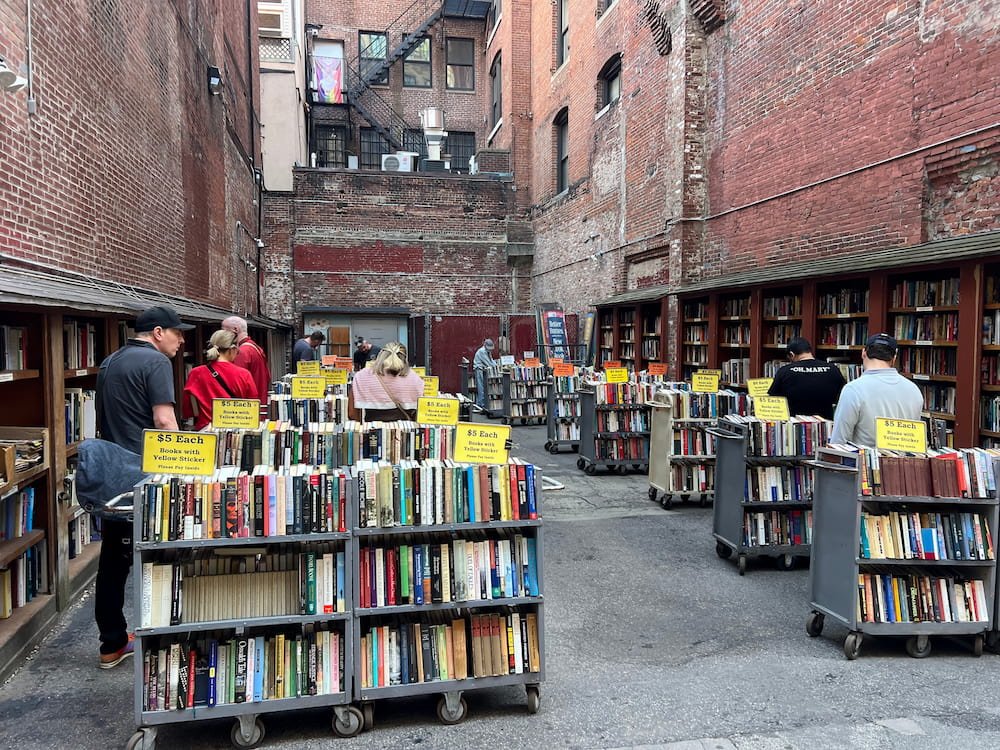
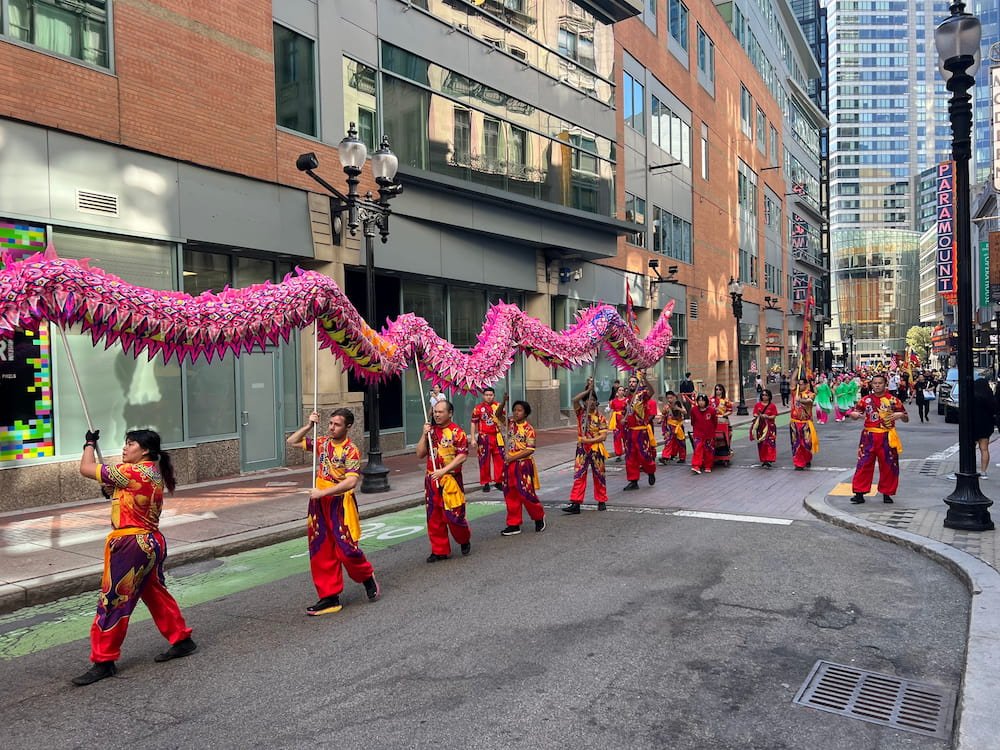
We passed by Brattle Book Shop, one of the country's oldest and largest used book shops, that's been around since 1825. It's a 3-story bookstore, but there's so many books that the bookcases spill out into the outdoor space next door, where people can wander around to peruse and purchase a tome or 3! Lisette loves bookstores, although she's had to resist spending too much time in these stores, lest she end up buying anything. Just as we were in the area, we could hear a parade quickly approaching us, which turned out to be the Taiwanese community celebrating its Double Ten Day (National Day) ahead of October 10, with dragon dances, percussion bands, and more. We didn't stay long however, as it's exactly the kind of noise that makes Sheila anxious.
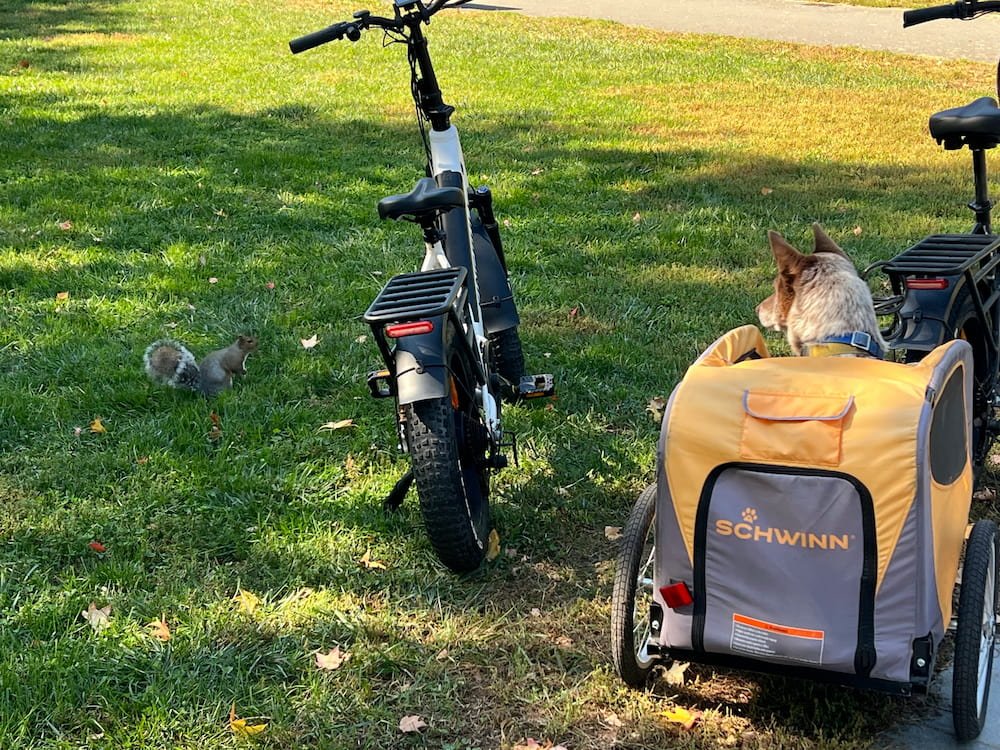
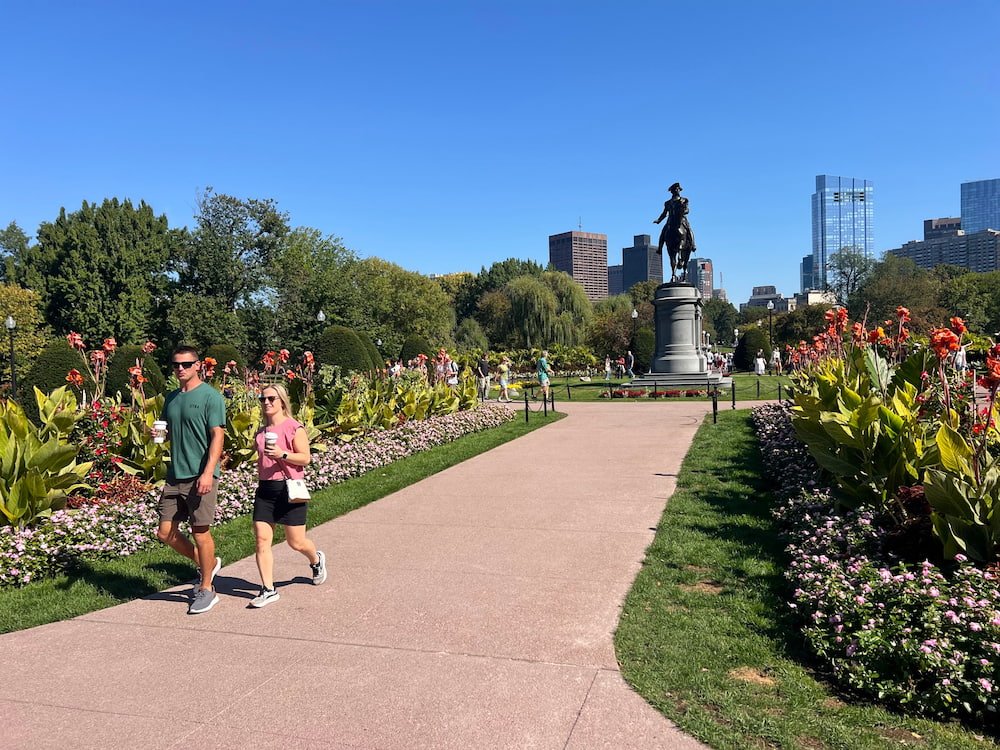
Founded in 1634(! so much history!), Boston Common is America's oldest park, and it was busy with people who looked like they were finishing up some kind of fundraising walk, in addition to tourists and...squirrels! Sheila was entranced by the many plump squirrels here, with their thick bushy tails scampering around. One was so bold as to tease her as she sat in her dog trailer, where she was locked in and couldn't jump out as the squirrel came tantalizingly close to her as she gawked. Squirrels here are fearless!
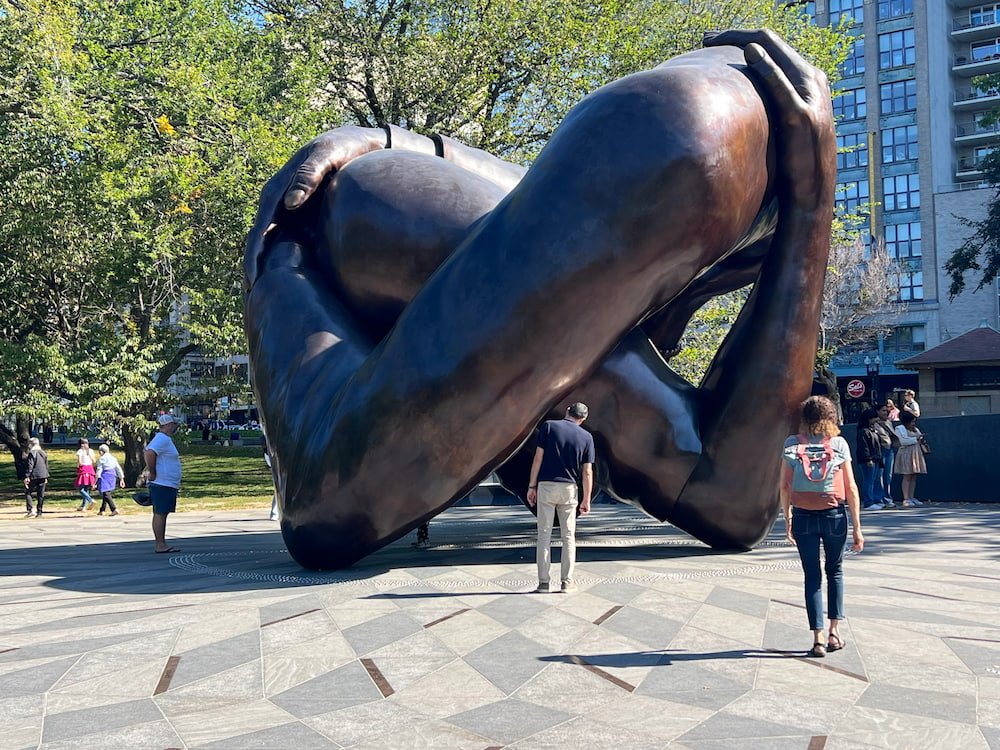
In Boston Common is a striking sculpture called The Embrace, a 20-foot (6 meter) tall bronze sculpture that's 32 feet (9.75 meters) in diameter. It's based on a 1964 photo of Martin Luther King Jr. and Coretta Scott King embracing after he received the Nobel Peace Prize, symbolizing their bond and love, and is of 4 intertwined arms, creating a ring that's impossible to determine where it begins and ends.
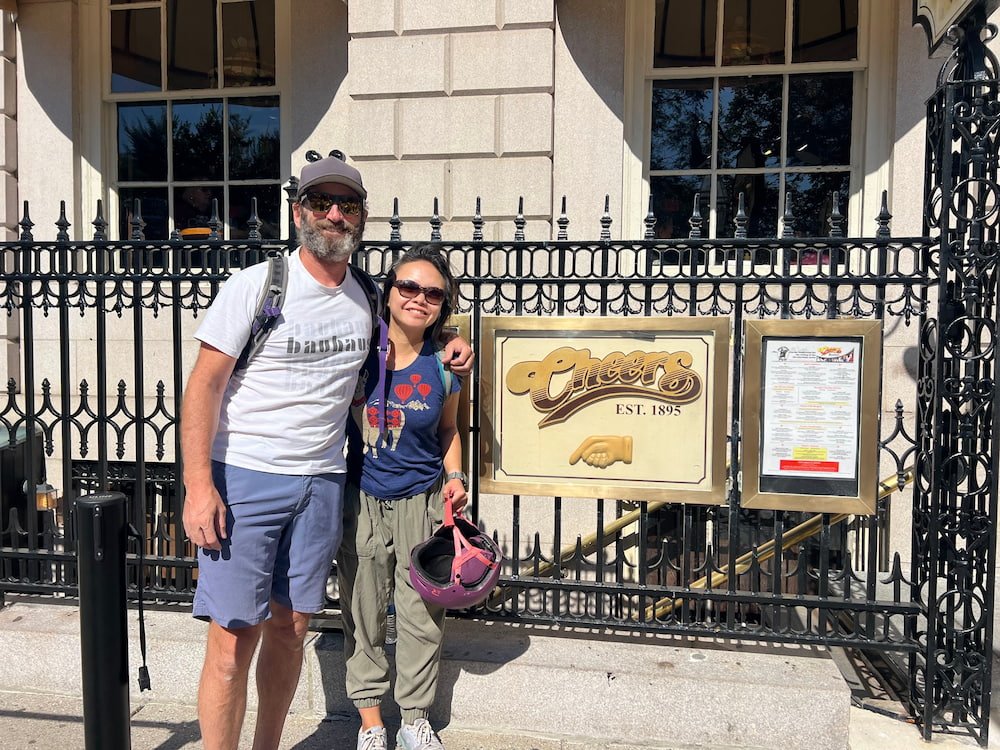
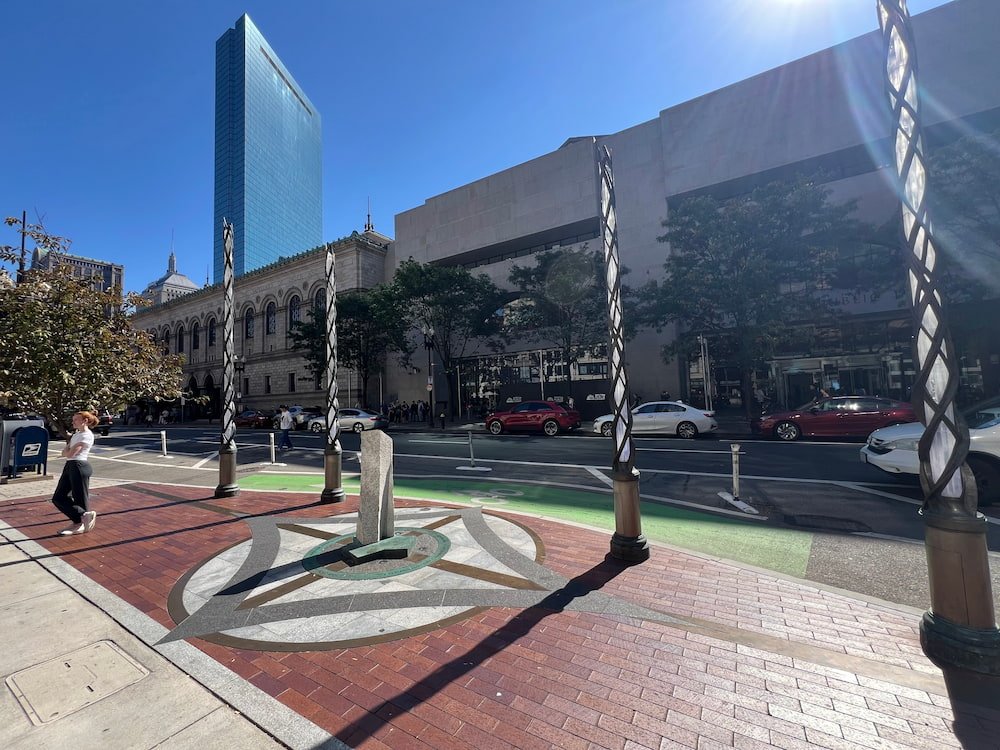
Leaving the park, we stopped at the front of Cheers, the bar that was the setting for the TV show of the same name that ran from 1982 to 1993. We'd been at the front of the bar during our last visit to take a photo, and did the same thing this time (sorry Paulie, we didn't end up going in to get a drink! A bit tough with our two e-bikes, Sheila and her dog trailer). We'd also visited the Boston Marathon Memorial during our last trip, but went back again to see it, which depicts 3 stone pillars representing the 3 victims who died at the race's Boylston Street finish line. The street was as we remembered it, lined with a ton of shops and restaurants on both sides, although it was even busier on a sunny weekend day like today, and we had to weave through traffic to get to the memorial, but fortunately got onto a dedicated bike lane so we didn't have to keep battling the scores of cars and people everywhere.
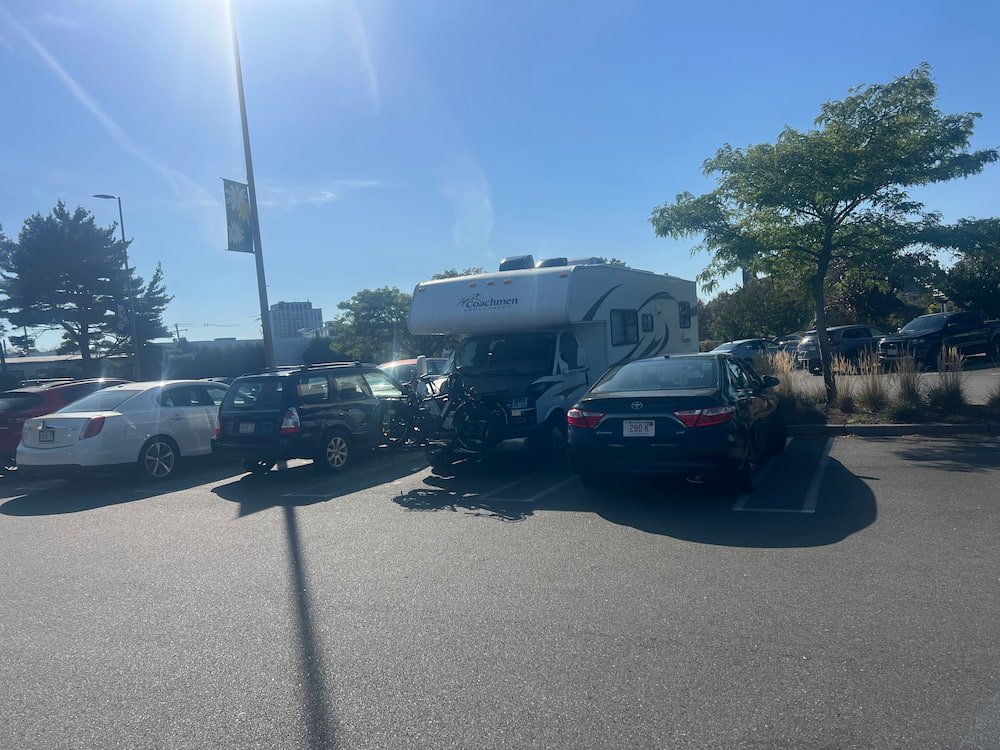
As we were cycling back to the RV, Lisette was following Michael and Sheila, when we all noticed a car get perilously close to Sheila's trailer! C'mon folks, it's a busy weekend but there was plenty of room on the road, and it was frustrating and intimidating to have this happen. Well, Lisette took this as our cue to wrap up our visit to Boston!
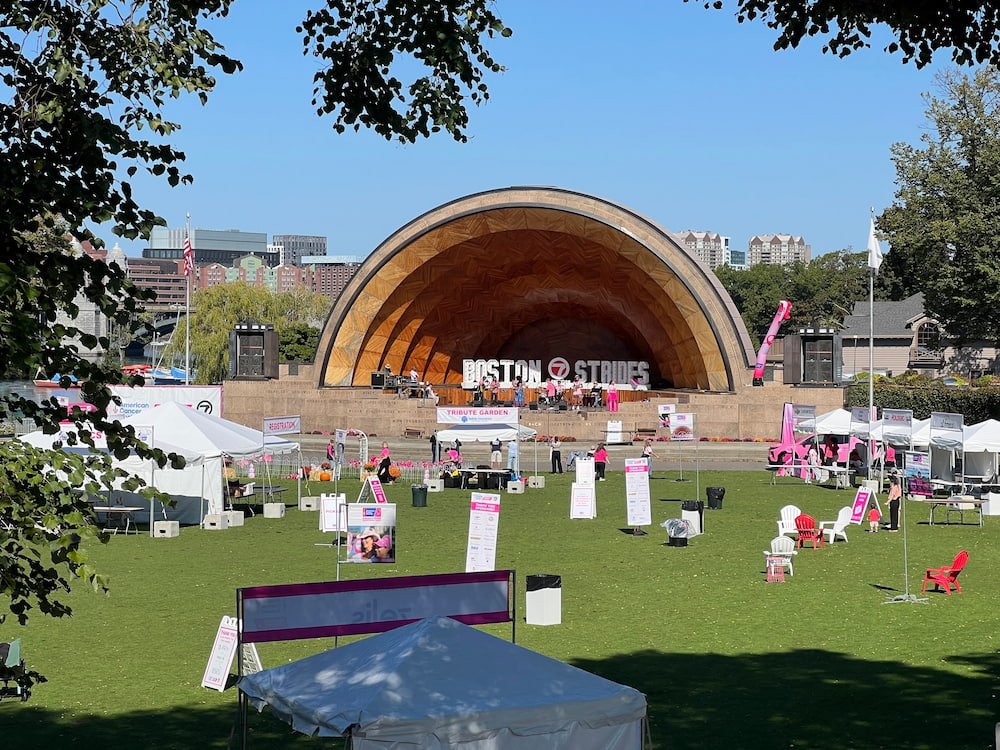
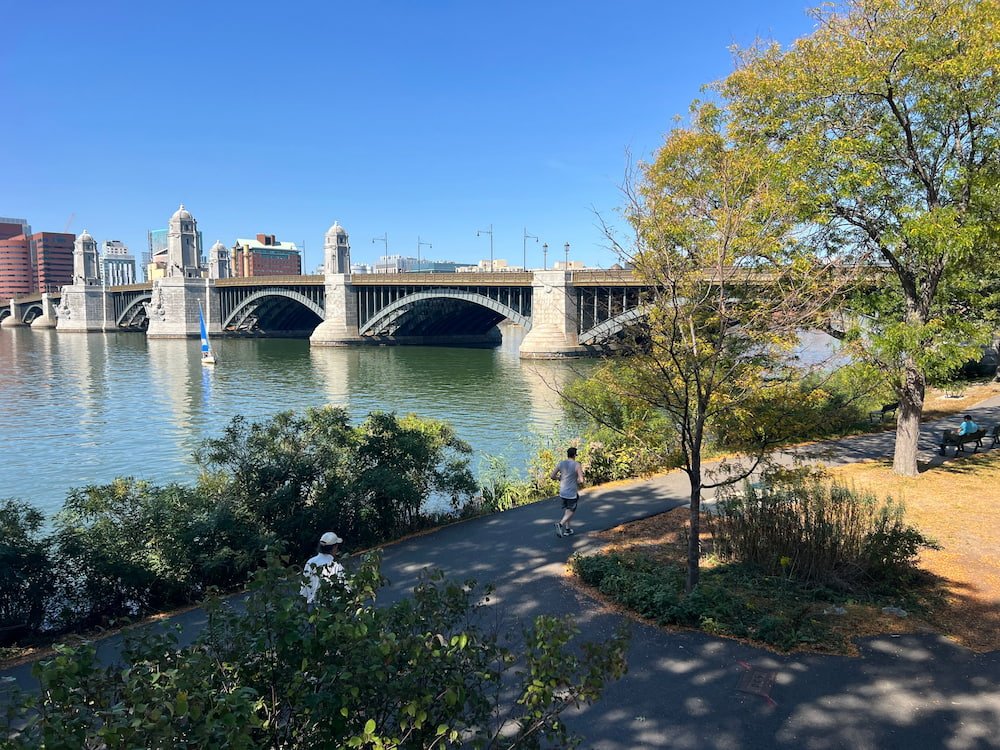
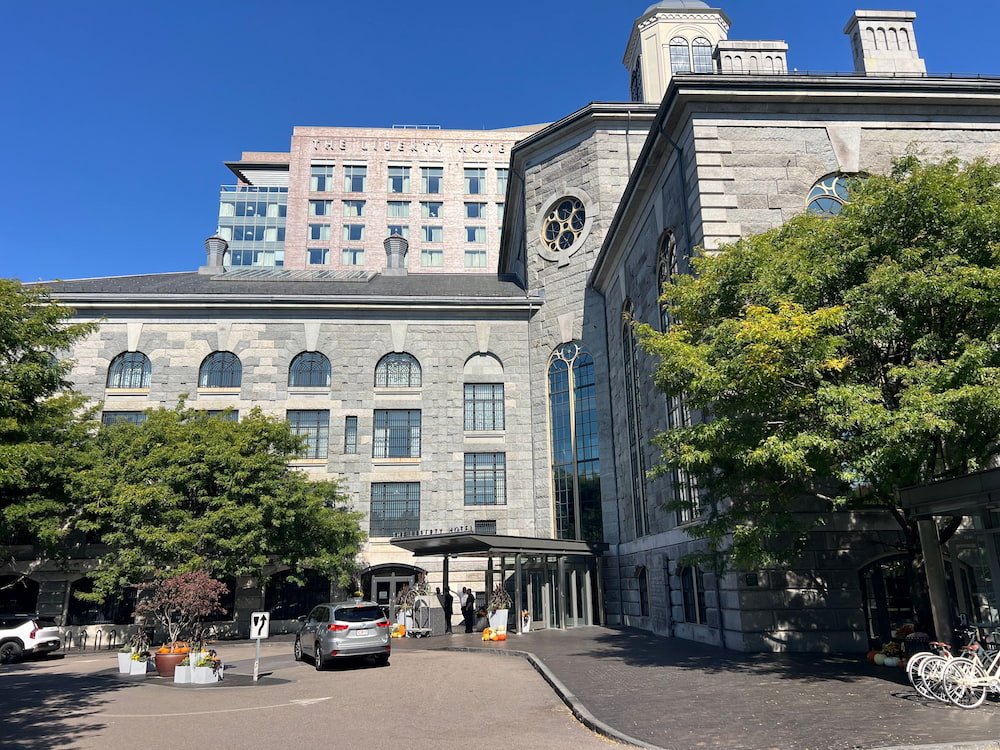
We got back to the RV, had lunch, and drove out, accidentally missing an exit (ergh, thanks Google for the delayed heads up), which meant we were stuck in highway traffic for an inordinately long time--clearly everyone wants to be out and about on a beautiful day like this! But we eventually got back on track, passing The Rainbow Swash--a Boston landmark of a rainbow design painted on a 140-foot tall LNG storage tank that was copyrighted in 1972.
More Firsts for Massachusetts
It turns out there's a lot of "oldest" or "first" places to visit in Boston and Massachusetts more broadly! In the city of Quincy (part of greater Boston), is the first-ever Dunkin' Donuts store, which still operates today. Originally called "Open Kettle," it was renamed to Dunkin' Donuts in 1950, and today there are over 14,000 stores across 40 US states and 40 countries around the world. Dunkin' Donuts isn't as popular on the US West Coast so we haven't really tried it, but Michael figured he'd try a coffee, as folks in Boston we talked to--even in Little Italy--mentioned that they loved it!
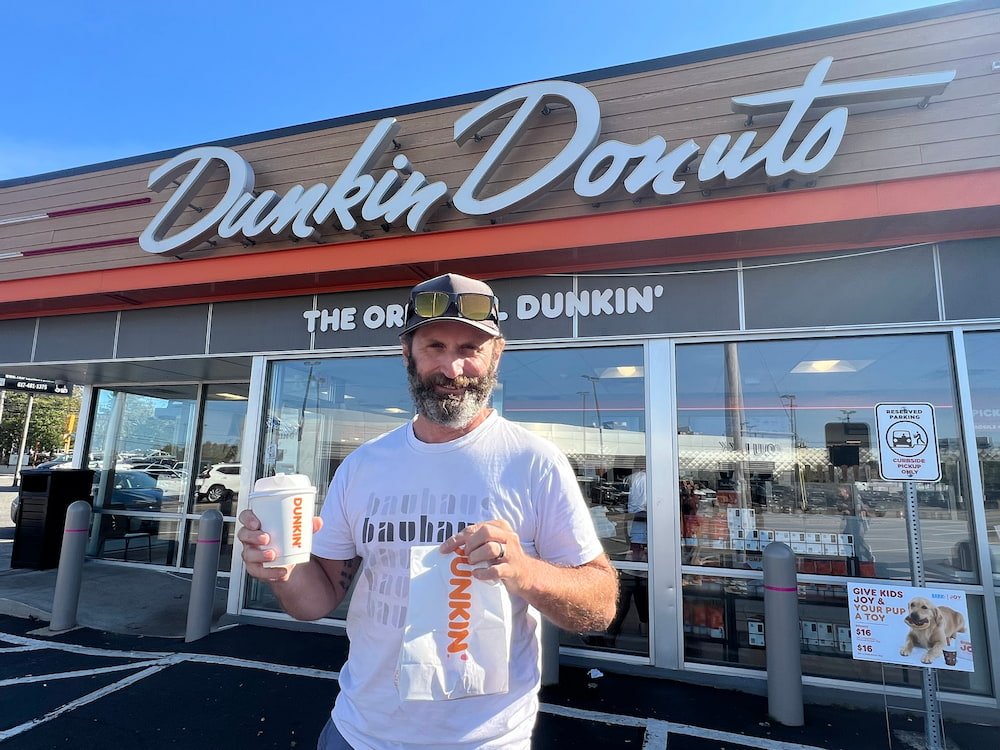
The store is small and looks retro, with a different font to what most stores have today, and there's a tagline underneath that says "The Original Dunkin'." Michael ordered a coffee and a couple of donuts (one Boston Cream, of course--a donut based on the classic Boston Cream Pie, a chocolate donut with cream inside). The verdict? For a chain coffee, Dunkin' wasn't bad--definitely better than Starbucks! It seems that instead of whole milk, Dunkin' uses coffee creamer, giving it a creamier taste. While Michael won't be rushing to order more of their coffee soon, it passes his connoisseur tastebuds.
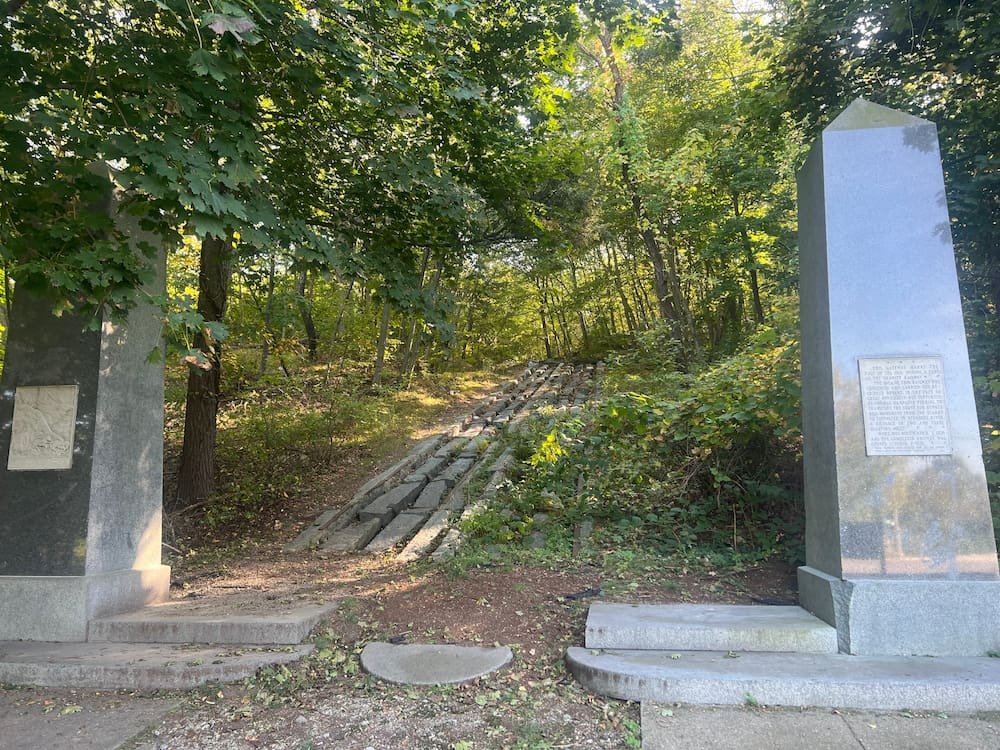
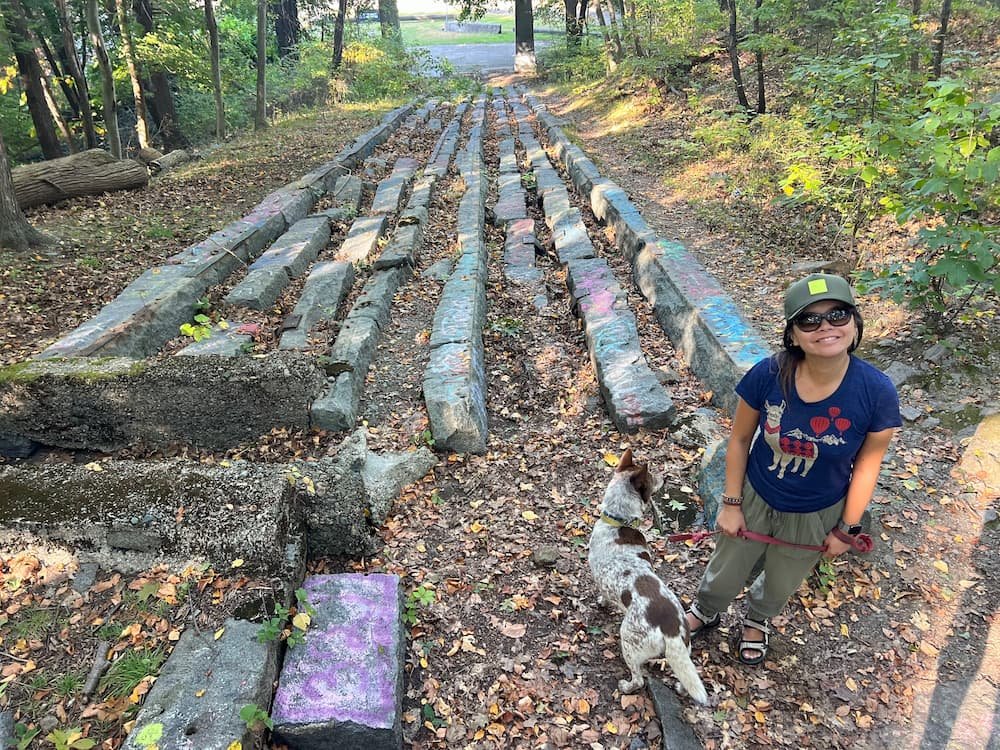
Also in Quincy, tucked within a residential area, we saw the remains of the Granite Railway Incline, the nation’s first commercial railroad, built in 1826 that used horse-drawn cars to carry the massive granite blocks from the Quincy Quarries for building the Bunker Hill Monument. The railway was built impressively quickly for a 'first', starting on April 1 and opened on October 7 of the same year (although it's only 2.75 miles, or 4.4 kilometers). Today, we could walk up the remaining track, which is surrounding by densely packed trees and some trails, and we also saw signs for rock climbing around this area. It was fascinating to walk around this slice of history, and Michael commented that we were pretty lucky to find these hidden gems in many of the places we've traveled!
America's Hometown
Anyone who's studied US history knows about Plymouth, known as "America's Hometown" as it was the site of the colony founded in 1620 by the Pilgrims, and where the first Thanksgiving feast happened. Lisette didn't know all of this, and years ago incorrectly pronounced the city as "Ply-mouth" rather than "Plim-moth" to some work colleagues, who found it hilarious!
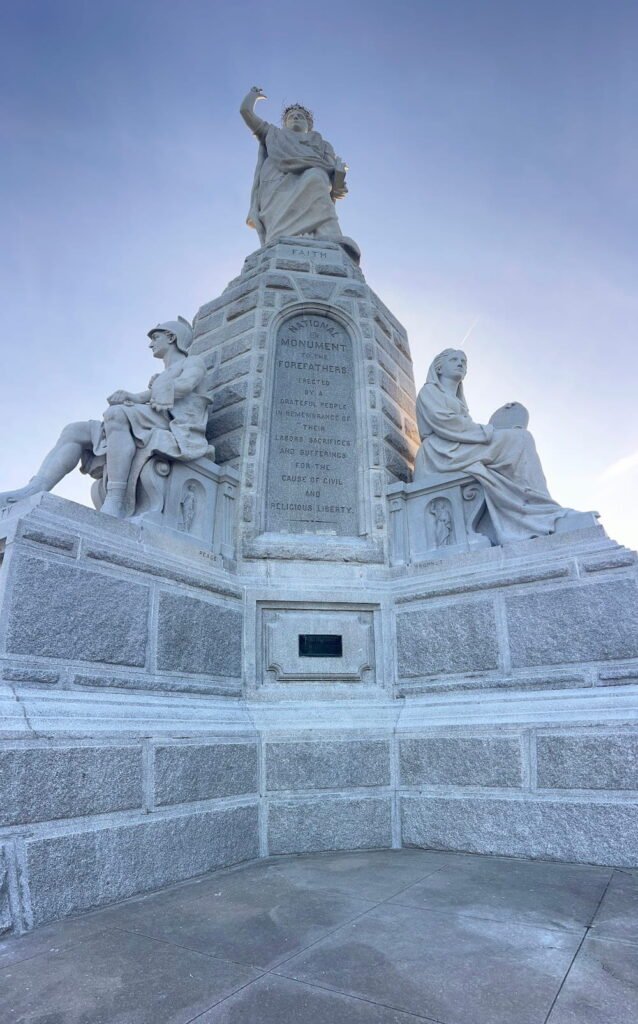
Anyhow, we traveled to Plymouth in the Greater Boston area, where we saw the National Monument to the Forefathers, a massive, 81-foot (24.68 meter) granite monument that honors the passengers of the Mayflower, the English merchant ship that famously transported the Pilgrims from England to the US back in 1620. The monument has allegorical figures depicting the virtues of Faith, Morality, Education, Law, and Liberty, and it's free to visit. Nearby is the Mayflower II, a full-scale, working replica of the 1620 ship that carried the Pilgrims, which we could see in the distance on the water (it was already closed by the time we got here). Interestingly, nobody knows what happened to the original Mayflower, although it was probably broken up for timber and repurposed for construction.
Driving around Plymouth, we were struck by what a quaint coastal place this was, perfect for a quick summer getaway, with a ton of nice-looking places to eat and shop. Since it's so close to Boston, it probably gets really busy over the summer, especially as it's on the way to Cape Cod.
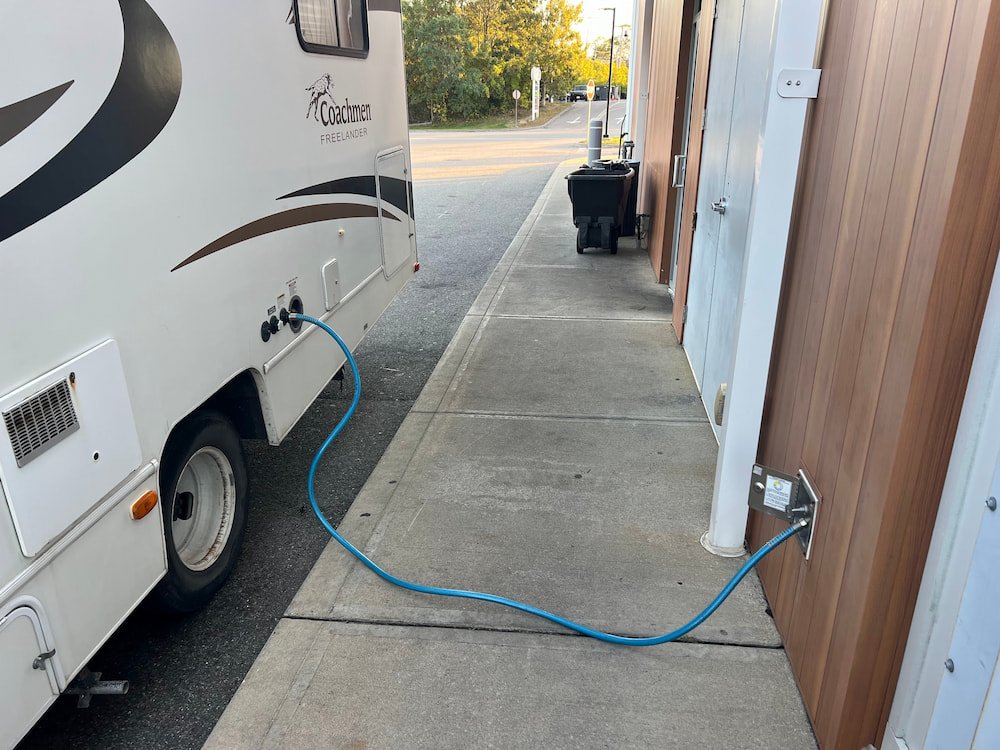
While we'd found a place to do a grey/black water dump just before Salem, we hadn't found a free and convenient place to refill on fresh and potable water, until now, at an Alltown Fresh location. We'd never been to one before, but it seems to be an upmarket gas and convenience store--unlike other petrol stations, going inside it's filled with more boutique and fancy food items. The employee working there was really love, giving Lisette a square key that was needed to unlock the tap behind the building before we attached the hose to pump potable water into our RV. It's always a relief to know we have enough clean water, and our grey/black water tanks aren't full!
In the evening, we found a visitor rest stop to park at that's near our first stop tomorrow. Lisette is so excited: we'll be visiting a cranberry farm and going into a bog!