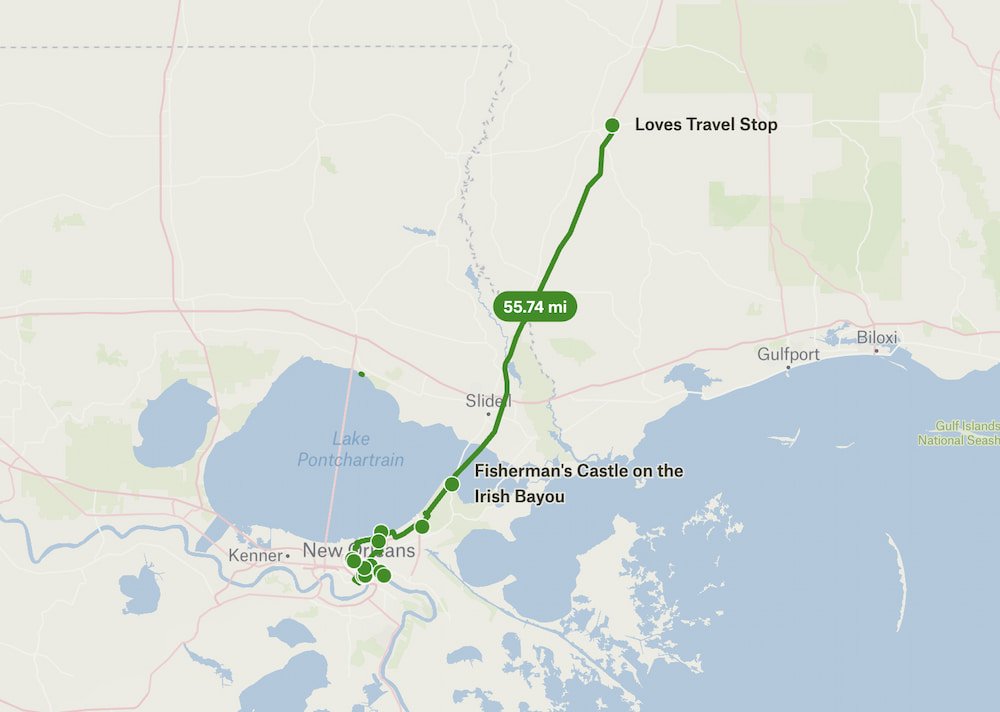
We visited New Orleans few years ago for several days, so we'd seen some of the top tourist sites, including Jackson Square, St. Louis Cathedral, Bourbon Street, the National WWII Museum, and we'd also been on a swamp tour. So while we'd revisit some of these places again, our focus would be on the newer and quirkier attractions this time around.
We arrived first at the Irish Bayou in New Orleans, where we were greeted by houses perched on stilts, clearly indicating the dangers of living in a low-lying area so prone to hurricanes and flooding. Our first stop was the the Fisherman's Castle on the Irish Bayou, which was built in 1981, and has withstood the natural disasters that have swept through the area since then. It's a house built to look like a small, white castle, that stands out because of its bright white paint, and grey pointy turrets. It looks uninhabited, and apparently is up for sale.

Further along, we wanted to see the remains of Jazzland, a theme park that opened in 2000 (and was renamed to Six Flags New Orleans), but closed 5 years later after Hurricane Katrina and the ensuing floods swept through. The area was closed off so unfortunately we couldn't check it out, but a silver lining was that that there was a sign noting that there is construction for this to become a film studio and entertainment complex, and it plans to open by 2027.


Still north of downtown New Orleans is Lakefront Airport. It's a brown sandstone building built in our favorite Art Deco style, and inside it's an incredible ode to the 1930s and the golden era of aviation. There's a retro cafe on the ground floor and a few offices, but the most impressive part of the building is upstairs, with various Art Deco-style paintings showing different aviation scenes from around the world, from Bali to New York, and an ornate roof in the middle. The airport still conducts flight schools and has charter operations, and we could see some of the aircraft through the back window in the runway behind the building.
New Orleans City Park
The New Orleans City Park was a lovely place to visit and see some of the attractions within its 1,300 acres. We enjoyed strolling around the Sydney and Walda Besthoff Sculpture Garden, a donations-based garden that sits on 11 acres, with paths leading to various outdoor art sculptures by artists from all over the world, including Lithuania, South Korea, France, the US and more (there was also a sculpture by Auguste Rodin, who sculpted the famous "The Thinker"). There are almost 100 sculptures in total, including of animals, people, and more abstract works of art.


While we didn't pay to enter it, there's also a cute park for kids called Storyland, which has dozens of sculptures of storybook characters. The entrance already greeted us with Humpty Dumpty and Little Bo Peep, and we could see Pinocchio, the 3 Little Pigs who built their houses from different materials inside, and more. It reminded us of Storybook Island in Rapid City, South Dakota, which was a free theme park for kids and families with various themed structures and rides based on various cartoon and fairytale creatures.

One of the most popular food places in New Orleans is Cafe du Monde, which has a restaurant in downtown New Orleans that is always busy, with people waiting to try their famous beignets, and perhaps have a chicory and coffee-blended drink. We'd been to the downtown location on our previous visit, and the line had been exceedingly long (although worth it--the beignets are delicious)! But the on at the City Park had no line whatsoever! We weren't in the mood though for beignets unfortunately, and would have been more in the mood for ice cream thanks to the hot and humid weather.


We'd been thinking of staying in the park overnight, but decided to find somewhere cooler, booking a couple of nights instead at the New Orleans RV Resort and Marina not too far from the French Quarter.
Leaving the park, we went towards the French Quarter, seeing some of the beautiful New Orleans historical architecture and colorful buildings along the way, but making a point to stop at the Doullut Steamboat House. There are two close of these houses, built in 1905 and 1912 respectively, and one is right near a field on the corner, which is the one we could see more clearly. The house was built by a steamboat captain and his son, and were designed to look like steamboats, with decks, and big white ornaments that look like how a steamboat is adorned--almost like a pearly white necklace as well. This area was completed devastated by Hurricane Katrina, but because it was built with ceramics, it was able to withstand the storm and flooding.


We checked into the RV Park, which had a pool--yay! It was designed to be like an infinity pool, with one edge having the water spill down like a waterfall below. The water was cold, much colder and refreshing than any pool we've been to at an RV Park, which was actually a welcome change! That evening, we watched a new documentary on Netflix called Katrina: Come Hell and High Water, which was about Hurricane Katrina and the events leading up to and after the disaster--and realized that we were actually in New Orleans during the 20th anniversary of it happening. It was almost surreal to realize this, and compared to our last visit, despite more time elapsing since then, we'd been more sensitive and aware of the lasting devastation that occurred, seeing the landscape and buildings that were never restored around us. It still feels that the aftermath of Katrina still lingers, and haunts the city to this day.


Route Map